


I have managed to end up with five bags of rye flour to get through so expect to see quite a few recipes with rye in coming up! Obviously rye bread is the first thing that comes to mind when you think of things made with rye, and I came across a picture on Pinterest of a beautifully marbled rye bread, half light and half dark coloured; I can't resist a beautiful bread so I knew that I had to give it a try, the result was both extremely attractive and delicious.

Both colours of dough are essentially the same basic mix, I simply added cocoa powder and treacle to one to colour it (the bread doesn't taste of chocolate), reason being that you need both doughs to rise at the same rate, if they were different you may end up with a loaf that is part under and part over-proved.
The bread is made with part rye flour and part strong white bread flour, so it is light and soft, but still wholesome; it is perfect for making very attractive sandwiches (especially with cheese), and also makes fantastic toast. I topped mine with a sprinkling of caraway seeds for an interesting flavour, and you could also add some to the dough if you like.

Despite the intricate looking pattern the loaf is actually very simple to shape, I used this video as a guide, and it didn't take very long to create the spiral, it is definitely a shaping technique that I will be using again; I will also be making this loaf again regularly to use up some more of my copious amount of rye flour...
If this recipe has inspired you to do some bread baking you may want to check out these fantastic looking loaves: I also have some spelt flour to use up so I will be giving this Rosemary Spelt Bloomer a go; this Brioche looks perfect, and as a bonus contains far less butter than the recipe I usually use! And how about bread made with soy sauce? I think it sounds like an amazing idea and this Soy Anadama Bread looks fantastic.

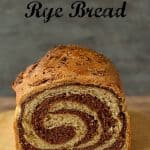
Marbled Rye Bread
Ingredients
Light Dough
- 225 g (1 + ¾ cups + 2 Tablespoons) strong white bread flour
- 115 g (scant 1 cup) rye flour
- 5 g (1 ½ teaspoons) fast action yeast
- 1 teaspoon salt
- 25 g (2 Tablespoons) softened vegan butter
- 1 Tablespoon maple syrup
- approx 220ml (scant cup) water
Dark Dough
- 225 g (1 + ¾ cups + 2 Tablespoons) strong white bread flour
- 115 g (scant 1 cup) rye flour
- 5 g (1 ½ teaspoons) fast action yeast
- 1 teaspoon salt
- 25 g (2 Tablespoons) softened vegan butter
- 1 Tablespoon treacle or molasses
- 2 Tablespoons cocoa powder
- approx 220ml (scant cup) water
- milk and caraway seeds to finish optional
Instructions
- Place all of the ingredients for the light dough except the water into a bowl and all of the ingredients for the dark dough except the water into a separate one. Gradually add the water to each bowl, mixing until it forms a soft, slightly sticky dough; you may not need to add all of the water or you may need a little more.
- Turn each dough out onto an un-floured surface and knead for about 10 minutes or so until they are smooth and elastic. Shape each dough into a ball and place in a lightly oiled bowl, cover, and leave to rise until doubled in size, about 1.5 hours.
- Grease an approx 28x13cm (11x5in) loaf tin (or you can just bake the loaf on a baking sheet). Punch down each dough and knead very briefly then divide each dough into 2 equal pieces. Roll each piece of dough out on a lightly oiled surface into a square about 20cm (8in) wide; stack the squares of dough on top of each other light then dark then light then dark; roll the stack out gently until it is about 27cm (10.5in) square then roll it up tightly into a log.
- Place the log seam side down in the loaf tin or on a baking sheet and cover loosely with oiled clingfilm. Leave to rise until doubled in size, 1-2 hours; meanwhile, heat the oven to 180C/350F/gas mark 4.
- Just before you place the loaf in the oven, cut several deep slashes across the top of the loaf, brush it with a bit of milk and scatter over a few caraway seeds if you like. Bake for 45-55 minutes until the loaf is well-risen and sounds hollow when tapped on the bottom, the internal temperature should reach 94C/200F.
- Turn the loaf out onto a wire rack and leave to cool completely before slicing.
Honest Mum
This looks epic, how original, I absolutely love rye bread although not sure I could pull this off! Thanks for linking up to #tastytuesdays x
hannahhossack
Thanks Vicki, it's easier to make than it looks! x
Karen
What is strong white bread flour? Can you suggest a brand?
hannahhossack
It is flour that has a high gluten and protein content and is therefore better for breadmaking than plain flour. It will be labeled as either "strong flour", "bread flour" or "strong bread flour". I don't use a particular brand and get good results just using supermarket own brand.
Mayuri Patel
a very rustic looking bread, crunchy and delicious. Love the perfect swirl.
hannahhossack
Thanks Mayuri 🙂
Barbara
This bread turned out perfect! So easy to make everyone loved it! If you love rye bread you have to make this! Thank you for this great recipe!
michelle spiziri
Hello! Mine got a bit dense and not as fluffy as yours. i'm not sure my yeast was fresh- it didn't rise very much (it seemed). could that be the reason? I also used maple syrup instead of treacle since I hadn't any. But overall it was pretty easy to put together. I'm not a seasoned baker-I'm quite doplic at it. but I also enjoy it-odd right?
Hannah
Hi Michelle, yes it does sound like the yeast could be the problem. Rising times are also only ever a guide and will vary a lot so it is important to go by the look and feel of the dough rather than a specific time. The bread is ready to bake when it has visually about doubled in size and if you gently press the dough with your finger it should spring back slowly, and leave a slight indentation. If it springs back quickly then it needs a little longer to rise.