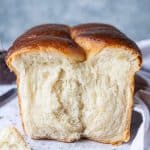
Vegan Brioche
Vegan brioche – this vegan version of the classic French bread is made with aquafaba instead of eggs. It is wonderfully soft, fluffy, rich and full of flavour. Includes options to make it with either vegan butter or olive oil.
Servings 1 loaf
Ingredients
Dough:
- 300 g (2 ½ cups) white bread flour
- 200 g (1 ⅔ cups) plain (all-purpose) flour
- 10 g (3 tsp) fast action/instant yeast
- 50 g (¼ cup) caster/granulated sugar
- 1 teaspoon salt
- 120 ml (½ cup) aquafaba (from 1 tin of chickpeas)*
- 200 ml (½ + ⅓ cup) unsweetened non-dairy milk (soy is best)**
- 1 tablespoon vanilla extract
- 200 g (7 oz / ½ + ⅓ cup) vegan block butter (NOT the spreadable kind. I use Naturli Vegan Block) OR 160ml (⅔ cup) mild olive oil (softened if using butter)
Glaze:
- 1 tablespoon non-dairy milk
- 1 tablespoon maple syrup
- ½ teaspoon sunflower/vegetable oil
Instructions
- Start the day before you want to bake the bread. Place the bread flour and plain flour in the bowl of a stand mixer fitted with a dough hook. Add the yeast to one side of the bowl and the salt and sugar to the other and mix to combine.
- Add the aquafaba, milk and vanilla extract and stir to form a rough dough then place the mixer on a medium speed and knead the dough until it is smooth and elastic. You can also knead the dough by hand on an unfloured surface instead.
- Add the softened butter or olive oil and mix until it is fully combined and the dough is smooth again, it will be quite soft and sticky. I actually find it easier to mix the fat in by hand rather than with the mixer (in a bowl, not on a surface if you are using olive oil). It will take a while to fully mix it all in and it will look like it is not going to work but trust me, keep going!
- Once the fat is fully mixed in, keep kneading until the dough pulls away from the sides of the bowl cleanly, it will still be quite soft and sticky however. Place the dough in a bowl, cover it and place it in the fridge to rise overnight.
- The next day the dough should have at least doubled in size. Line a 2 - 2 ½ lb loaf tin with baking parchment. My loaf tin measures 11.5 x 21.5 cm / 4.5 x 8.5 in. You don't want it to be any smaller than this; a 13 x 23cm / 9 x 5 in one would also be fine.
- Punch down the dough then you have a couple of options for shaping it. You can simply shape it into a loaf and place it in the lined tin; or to make a loaf as pictured that you can pull apart, divide the dough into either 6 or 8 even pieces (I prefer 8).
- Shape each piece into a smooth ball. To do this, pull the edges of the piece of dough in towards the middle and pinch them together. flip the ball over onto a lightly floured surface and cup your hand around it. Gently roll the ball on the work surface to form a smooth ball. Repeat with the rest of the dough portions.
- Arrange the balls in two rows in your loaf tin. You will probably have to squish them together to fit them in.
- Loosely cover the tin and set aside to rise until doubled in size. Because the dough is so heavily enriched this can take some time, about 1 - 2.5 hours depending on how warm it is. It is ready when it is puffy and if you gently poke it with a finger it springs back slowly. If it springs back quickly then it needs longer; and if it deflates then it is over-proved and you will need to punch it down, reshape it and let it rise again.
- When the loaf is nearly ready, preheat the oven to 180°C/350°F/gas mark 4 and prepare the glaze. Simply whisk together the milk, maple syrup and oil in a small bowl.
- When the loaf is ready, gently brush it with some of the glaze, try not to let it drip down the sides as that can cause it to stick to the tin and hinder the oven spring.
- Bake the brioche for 20 minutes then brush it with more of the glaze, turn the oven down to 160°C/320°F/gas mark 3 and bake for a further 25-30 minutes until the internal temperature reaches 94°C/201°F on a probe thermometer. If you don't have a thermometer then a skewer inserted into the centre should come out clean. If it starts to darken too much on top before it is ready then you can loosely cover it with tin foil.
- Once the loaf is ready, let it cool in the tin for 15 minutes then turn it out onto a wire rack and let it cool completely before slicing. Once cool store in an airtight container.
Notes
- For the best results make sure that you follow the recipe closely. As always, I highly recommend using the gram measurements (with a digital scale), rather than the cup conversions. Cup measurements are simply not accurate enough for baking and I cannot guarantee the best results if you use them.
- Do not reduce the amount of fat. Brioche is supposed to be a very high fat bread. If you want to bake a loaf of bread that is lower in fat but still wonderfully soft and fluffy then you should make my vegan Hokkaido milk bread instead.
- If you are making the butter (margarine) version then you MUST use the kind that comes in a solid stick, NOT the spreadable kind in a tub. It has too high a water content. I use Naturli Vegan Block or Stork Block. If you cannot get hold of block margarine then you should make the olive oil version instead.
- This is an enriched bread dough (meaning that it contains milk, fat and sugar rather than just water). This makes it soft and delicious, but also means that it takes longer to rise. The time it takes will vary depending on how warm your kitchen is.
- Giving the dough it’s first rise overnight in the fridge improves the flavour and firms the soft dough up, making it easier to shape.
- This bread is meant to be sweet, but if you want it a little less sweet then you can halve the amount of sugar. DO NOT omit it completely as some sugar is needed for the texture and to help with the rise.
- *To get aquafaba, just use the liquid drained from a can of chickpeas. The liquid from one tin should be sufficient for this recipe – 120ml/1/2 cup. If there is slightly less that that in the tin then you can just top it up to the 120ml/1/2 cup line with milk or water.
- I don't know what you could use instead of the aquafaba. I haven't tested anything else and can't think of anything that would work in the same way. Sorry.
- **Unsweetened soy milk is the best kind of milk to use here. You can use another non-dairy milk but soy really is best as it is the most similar to dairy milk. It has a high protein and fat content and soy also contains lecithin which helps create a better crumb structure.
- I use part bread flour and part plain white flour for the best texture but you can use all bread flour or all plain if that is all you have.
- The best way to tell if a loaf of bread is cooked in the middle is to use a probe thermometer. It is impossible to give a one-size-fits-all baking time as ovens vary so much.