

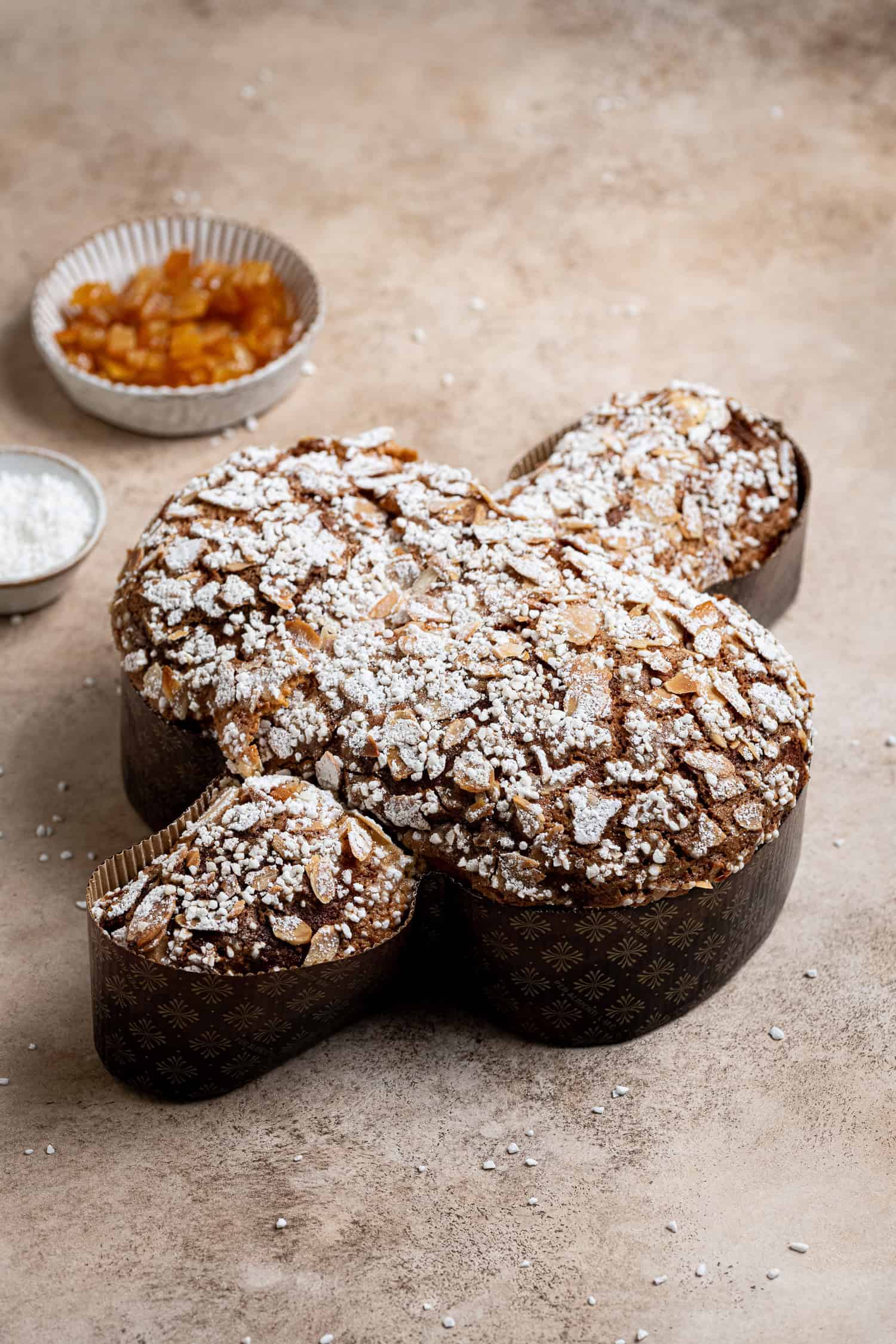
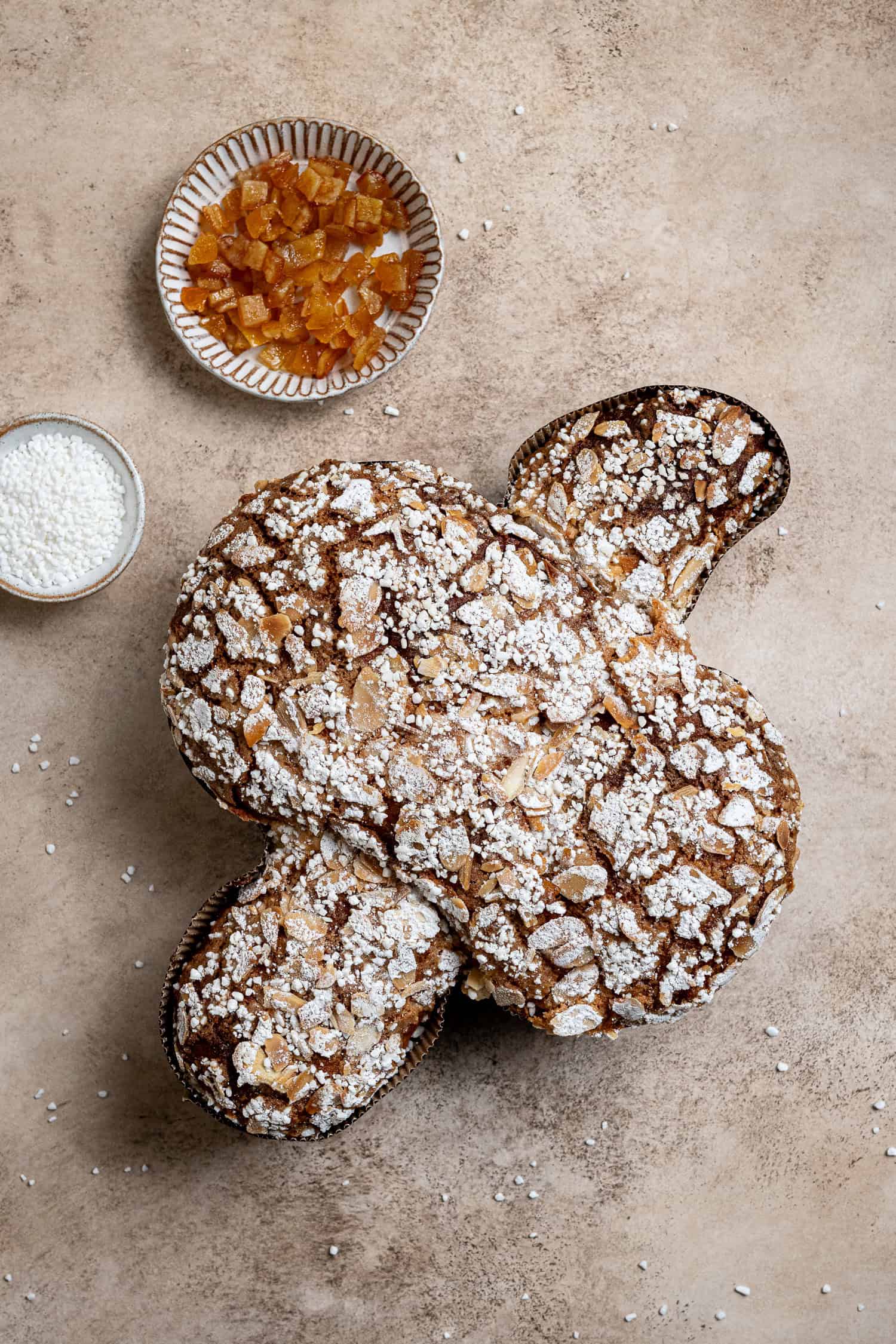
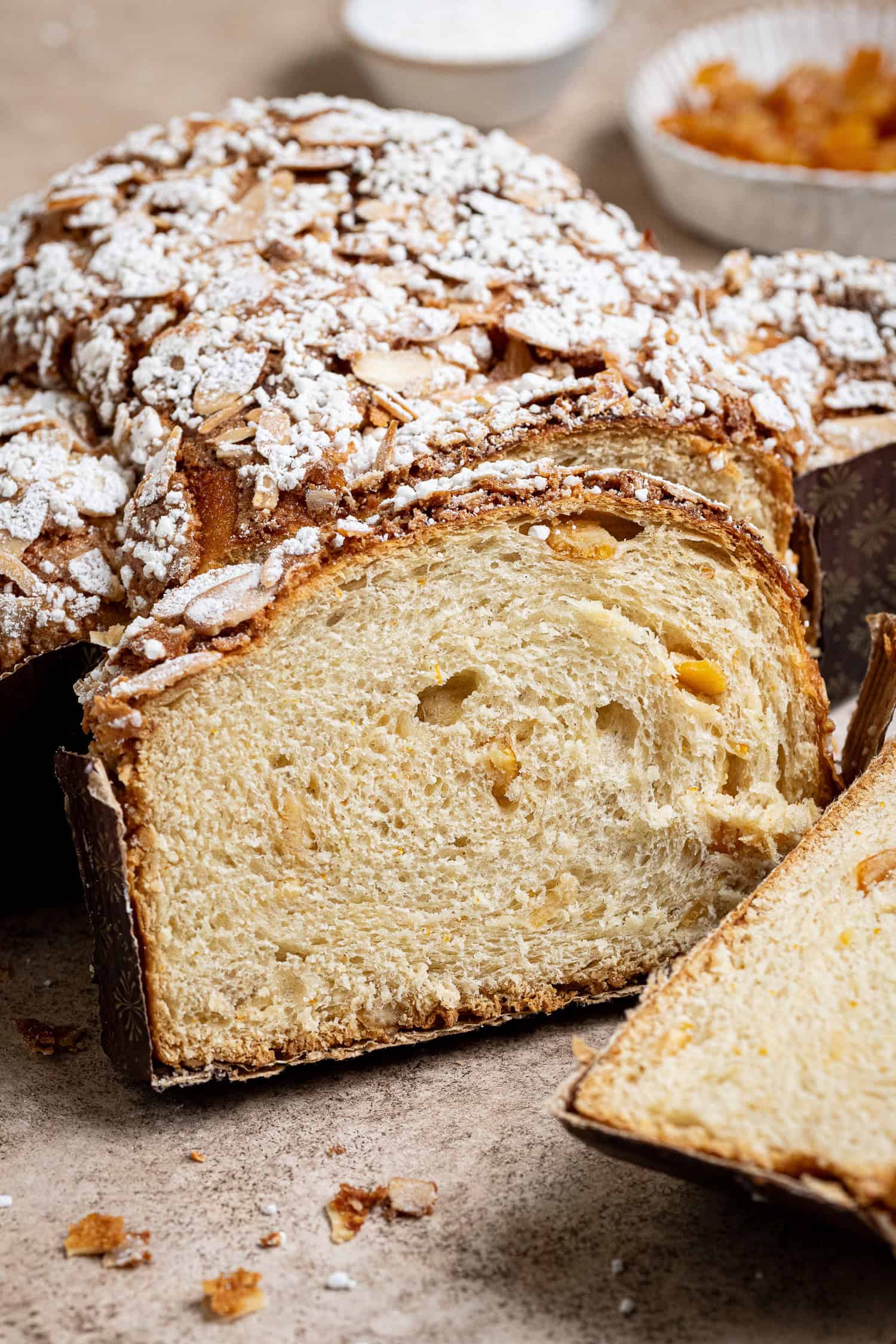
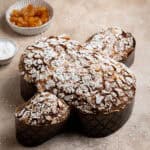
This vegan Colomba Pasquale is light, fluffy and rich with a sweet, citrus-scented flavour and is studded with candied peel and topped with a crunchy almond sugar topping.
It is an Italian Easter classic and is well worth making the effort to bake your own!

This vegan Colomba Pasquale recipe is essentially an Easter version of my vegan panettone, and is the recipe that I based my version of panettone off of. It is essentially the same dough and process as the panettone, but flavoured with orange and candied peel instead of raisins, and topped with a crisp sugar and almond topping.
I used this Colomba recipe from King Arthur Baking, and this one from Emiko Davies as the basis for my recipe; essentially making a veganised version of Emiko's, but adapted to use an overnight starter as per the King Arthur recipe, and slightly reducing the volume of dough as I found it to be too much for the mold.
What Is Colomba Pasquale?
Colomba Pasquale, also known as Colomba Di Pasqua, is an Italian Easter bread with a sweet, buttery, slightly citrussy flavour and an extremely light, soft, fluffy texture, studded with candied peel and usually topped with a crisp sugar crust and almonds. They are baked in paper moulds in a dove shape - the name literally translates as "Easter Dove". Colomba Pasquale is the Easter version of Panettone and is made using a similar dough and process, simply baked in a different shaped mould.
The process to make a traditional Colomba Pasquale is long and complex, taking several days with multiple rises and stages of making the dough. It is made using a stiff sourdough starter rather than commercial yeast which gives it it's unique flavour and light, airy crumb. Once baked, commercial Colomba Pasquale must be cooled upside-down to avoid it collapsing in on itself as the structure is so light.
Traditional Colomba Di Pasqua is heavily enriched with butter and egg yolks so is obviously not vegan friendly. The butter is an easy swap for a vegan block butter, but the egg yolks are more difficult to replace. In the end I had the best results by merely replacing the moisture they provide with extra soya milk rather than with any kind of egg replacer.
This vegan Colomba Pasquale recipe is a simplified version, more suitable for a home kitchen, using fast action yeast rather than sourdough, but it is still a complex recipe with very little margin for error. I would not necessarily recommend attempting this recipe if you are a beginner bread maker; you need to be able to competently shape dough and recognise when it is properly kneaded and prooved.
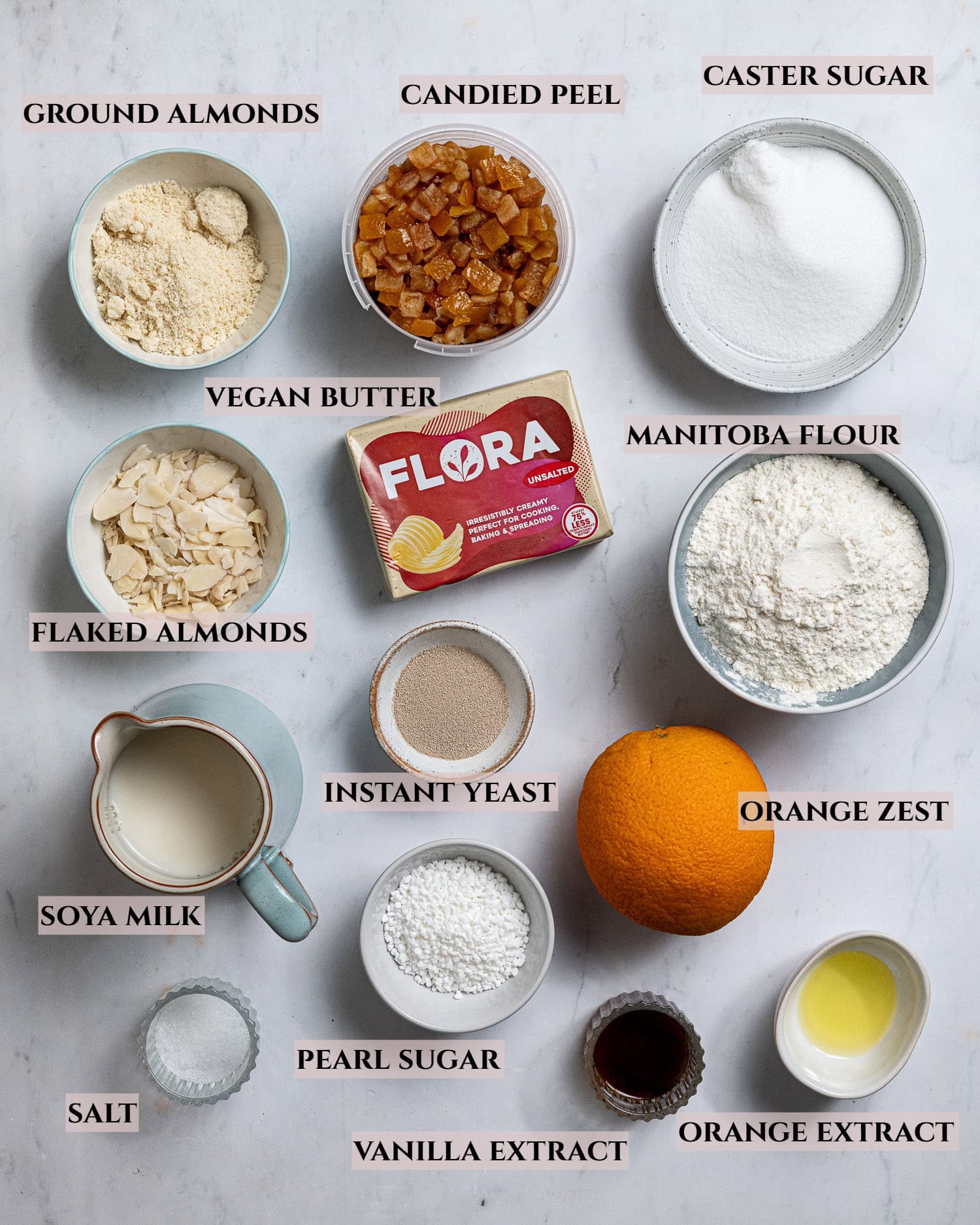
Ingredient Details:
Bread flour: You absolutely must use a strong white bread flour to make vegan Colomba Pasquale, do not use plain/all-purpose or wholemeal flour. The higher the protein content the better, I had the best results using Manitoba flour, which is a Canadian flour with a protein content of around 14% (regular bread flour is around 12%). You can also buy flour specifically for making panettone which has a protein content of 15-16%.
Yeast: This recipe uses fast action/instant yeast.
Butter: You must use a vegan block butter, not the spreadable kind in a tub which has too high a water content.
Milk: I recommend soya milk as it has the highest protein content. Others such as oat or almond should still work ok, but make sure that it is unsweetened.
Sugar: Use either caster or granulated sugar, I don't recommend swapping this for any other kind of sugar or sweetener. You will also need pearl sugar and icing (powdered) sugar for the topping.
Salt: Absolutely necessary. Salt in bread dough is not just for flavour, it also strengthens the gluten for better dough structure, controls fermentation and helps preserve the bread for longer. I use fine table salt so that it mixes into the dough easily and evenly.
Orange zest and vanilla and orange extracts: These all add essential flavour to the Colomba Pasquale. The orange extract can be swapped for orange blossom water.
Candied peel: This is a classic addition to Colomba Pasquale, but if you aren't a fan then you can use chocolate chips instead. If using candied peel, try and buy a good quality one as the flavour will be so much better!
Almonds: The topping is made with ground almonds (almond flour), which I then scattered with flaked/slithered almonds. Tradtionally it would be studded with whole almonds so use those instead of the flaked if you prefer.
Equipment:
You will ideally need:
- A 1kg Colomba Pasquale mould, I recommend the sturdier corrugated card ones rather than thin paper
- A probe thermometer
- A stand mixer
- A digital scale
How To Make Vegan Colomba Pasquale:
(Full measurements and instructions can be found in the recipe card at the bottom of the page)
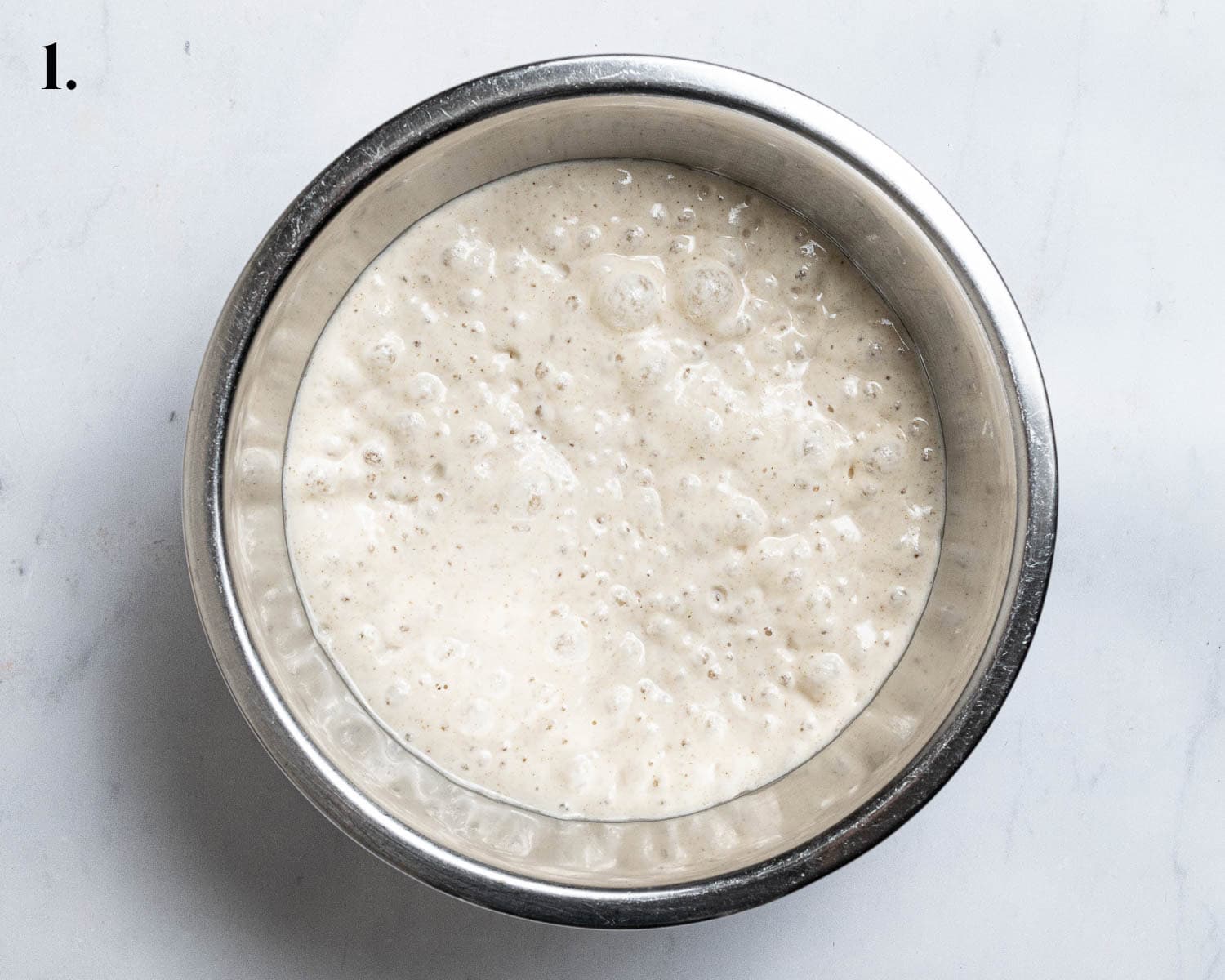
- Step 1: Start the evening before you want to bake the panettone. Mix together the flour, water and yeast to make the poolish, cover and leave to ferment at room temperature overnight.
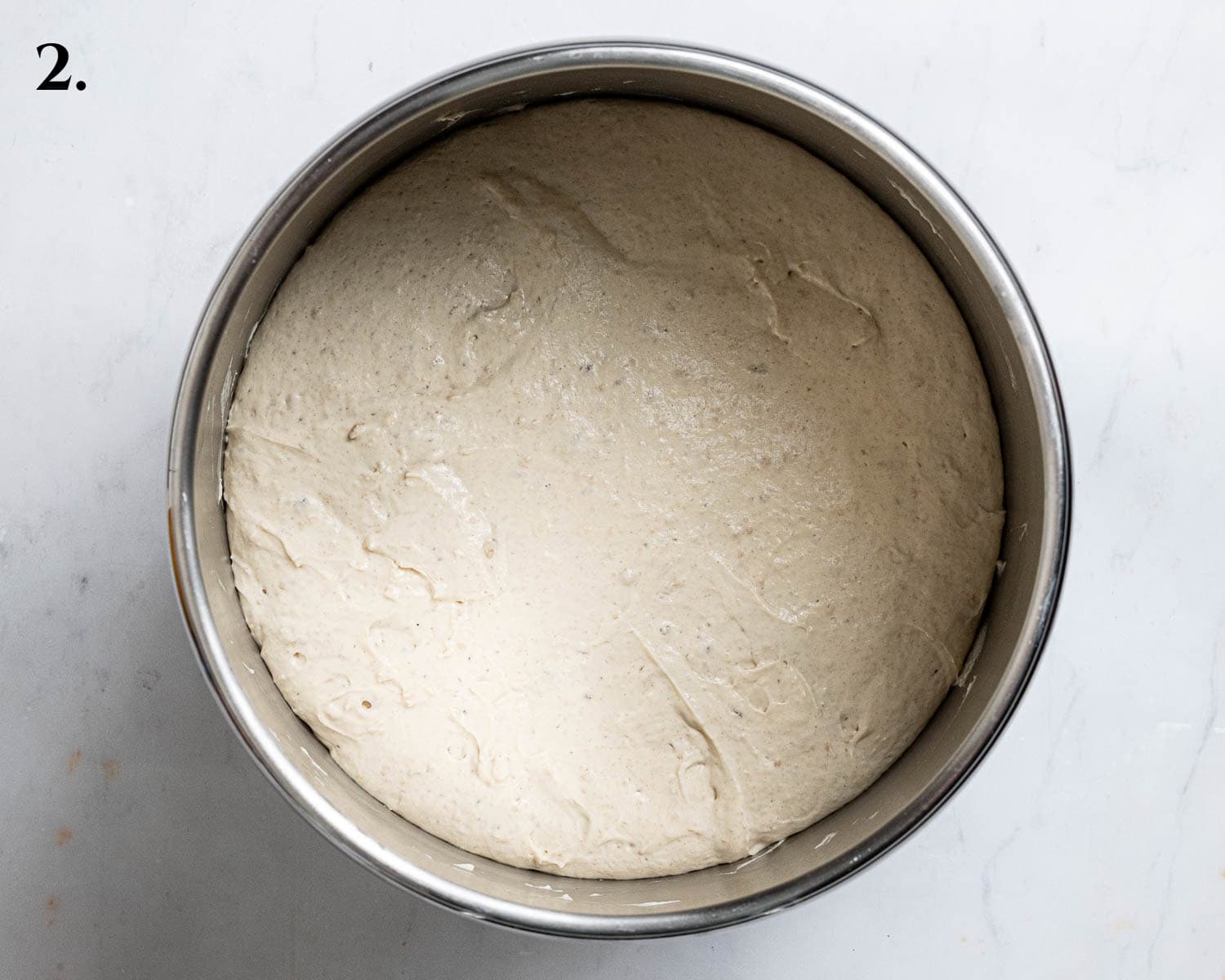
- Step 2: The following morning, scrape the poolish into the bowl of a stand mixer fitted with a dough hook, add flour, lukewarm milk, yeast and butter and mix until well combined. Cover and let rise until doubled, 1-2 hours.
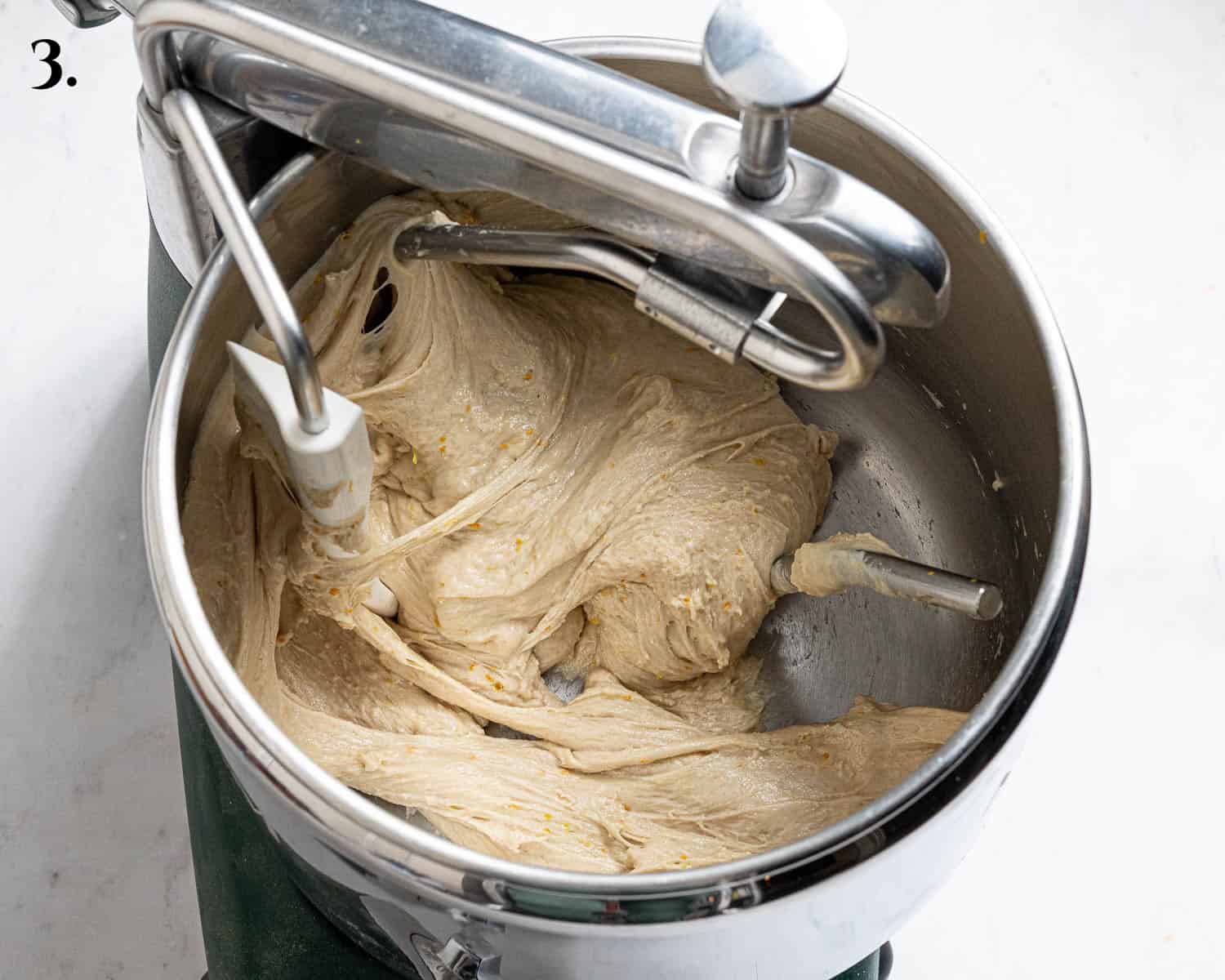
- Step 3: Add flour, sugar, orange zest and vanilla and orange extracts to the dough in the stand mixer. Knead until it is very stretchy and stringy.
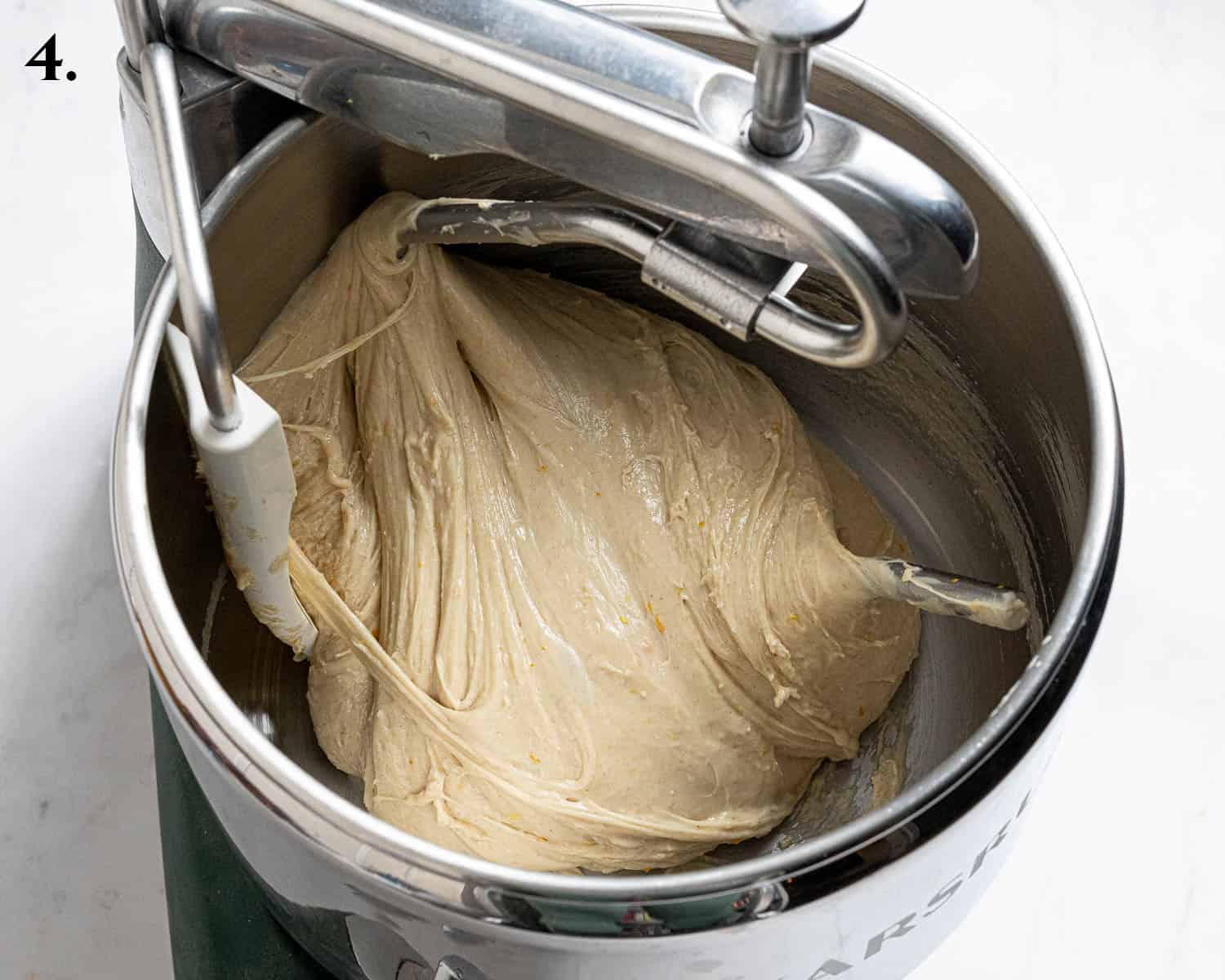
- Step 4: Knead in the butter a little at a time then finally add the salt and mix until well combined.
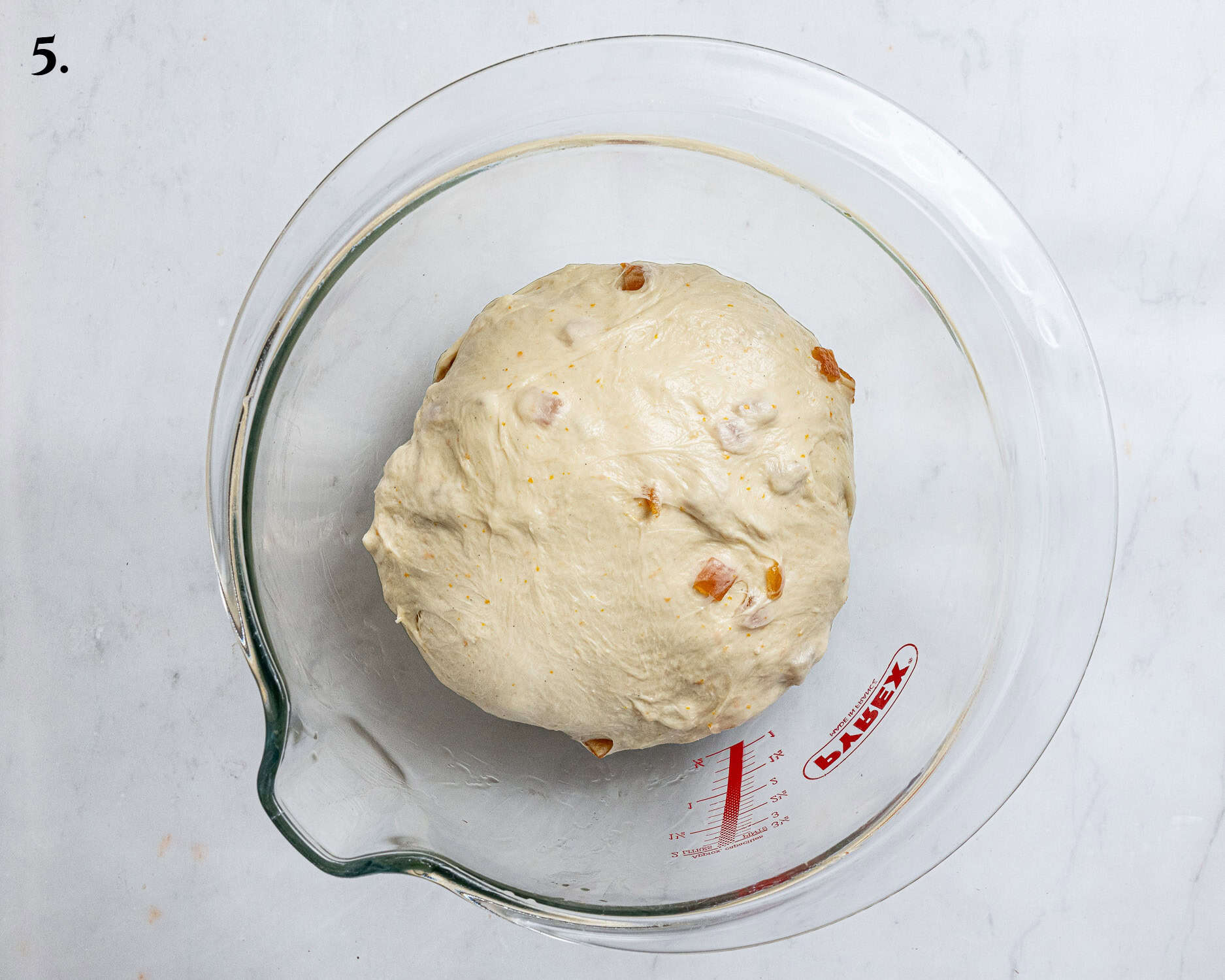
- Step 5: Add the candied peel and mix until well distributed. Shape the dough into a ball and place in a lightly oiled bowl.
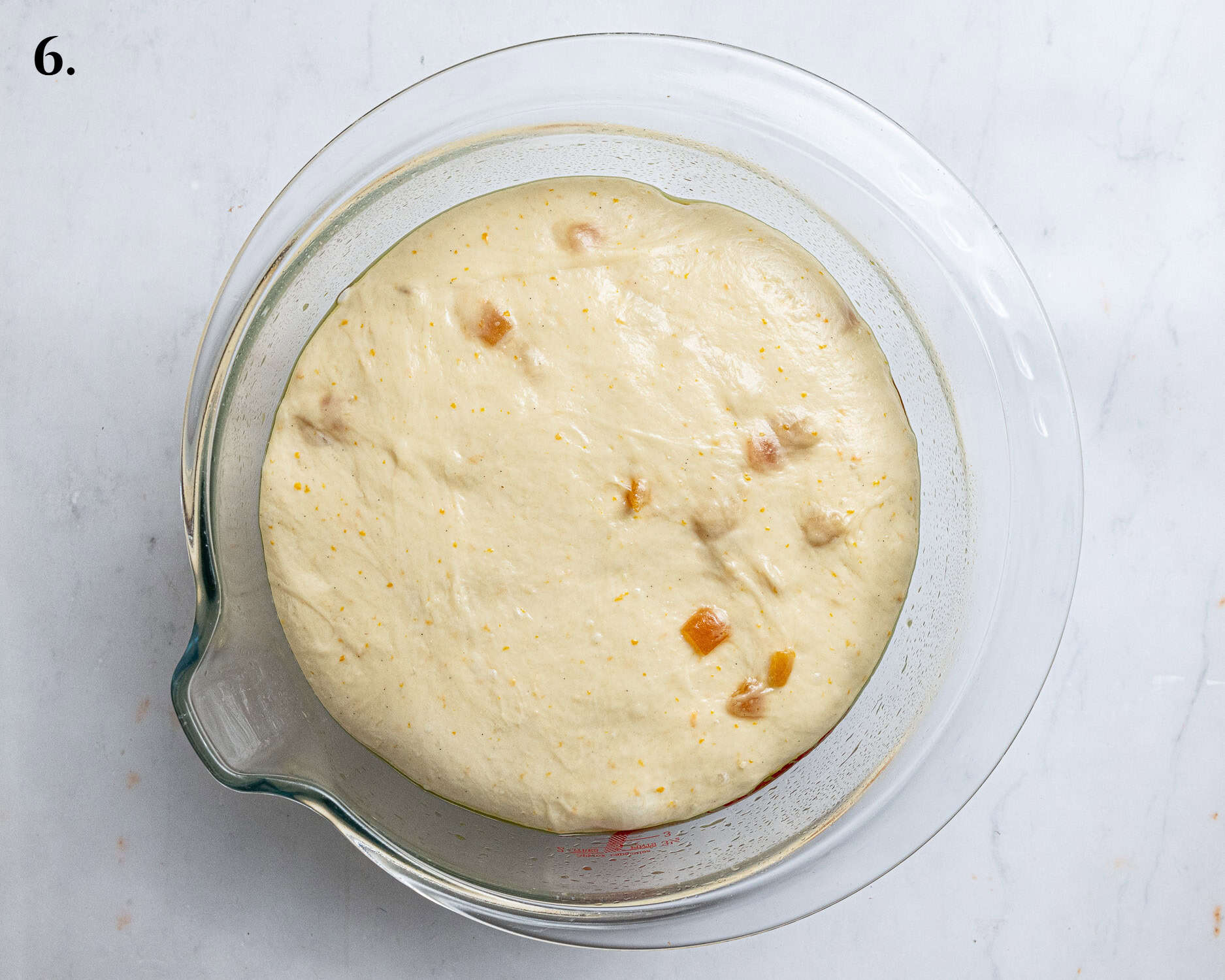
- Step 6: Cover and set aside to rise until about tripled in size, about 4 hours.
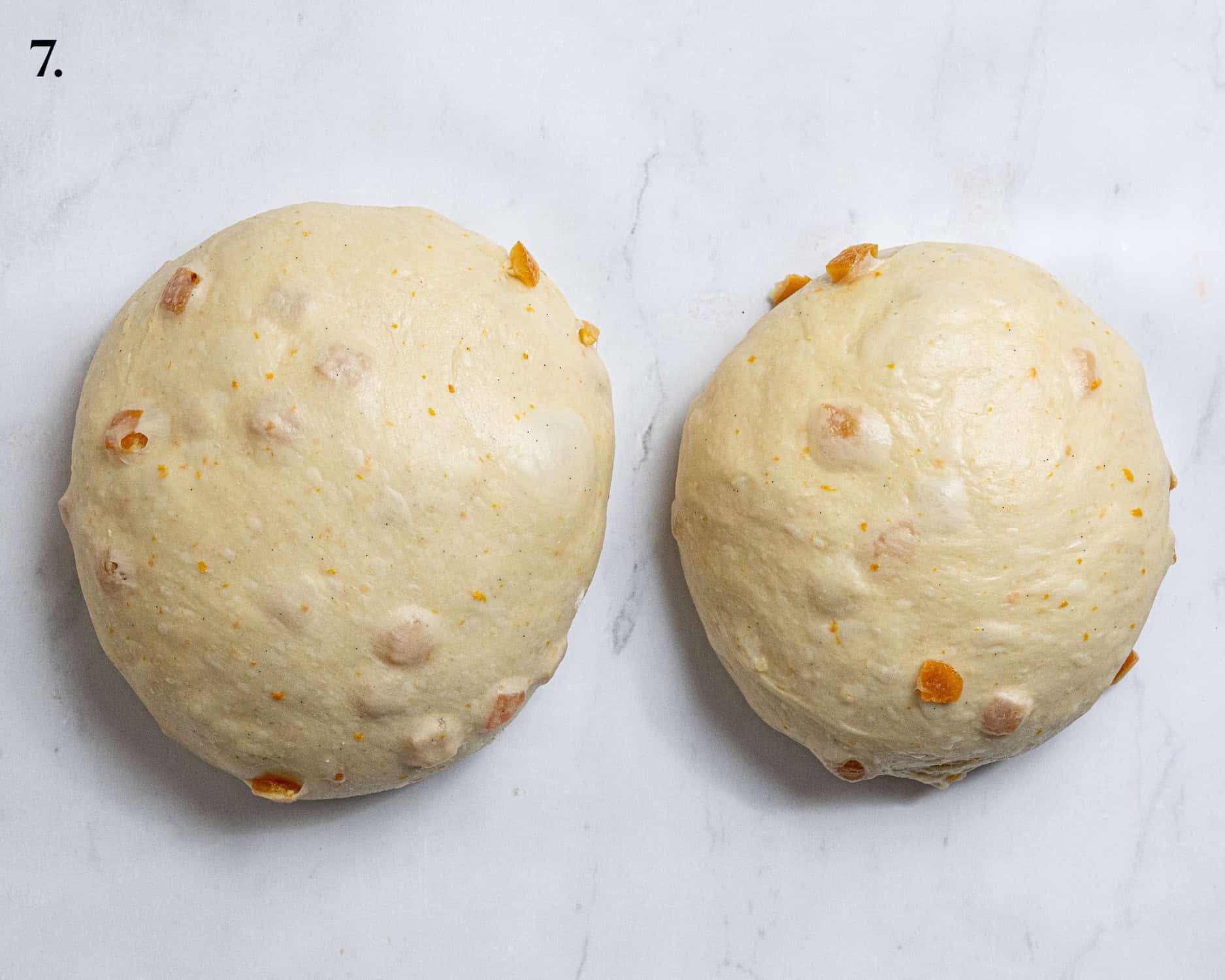
- Step 7: Punch down the risen dough, divide it into two pieces, one just slightly larger than the other, and shape each into a ball.
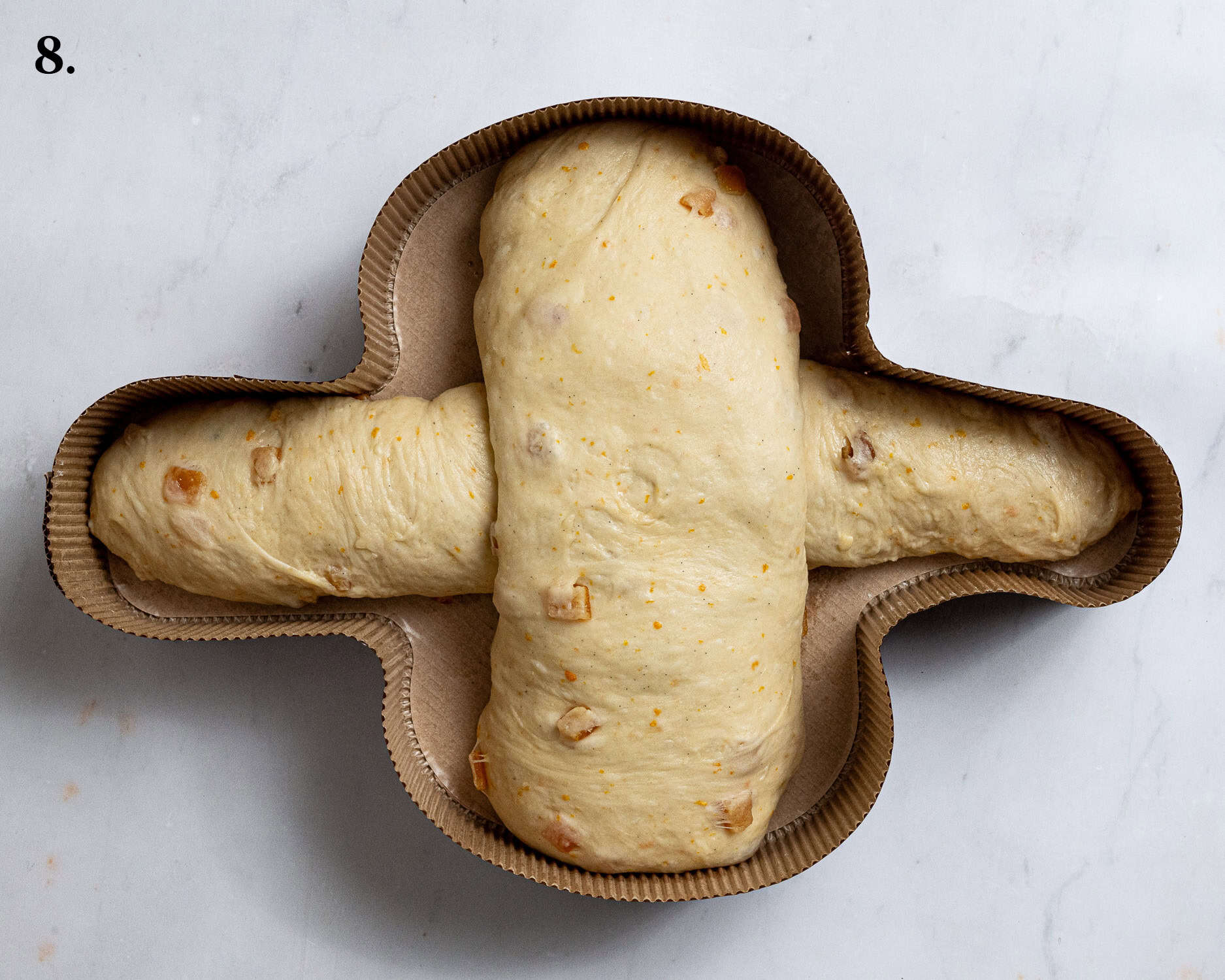
- Step 8: Shape the smaller piece into a long, skinny log and place it lengthways in the mould. Shape the larger piece into a short, fat log and place it across the mould on top of the skinny log.
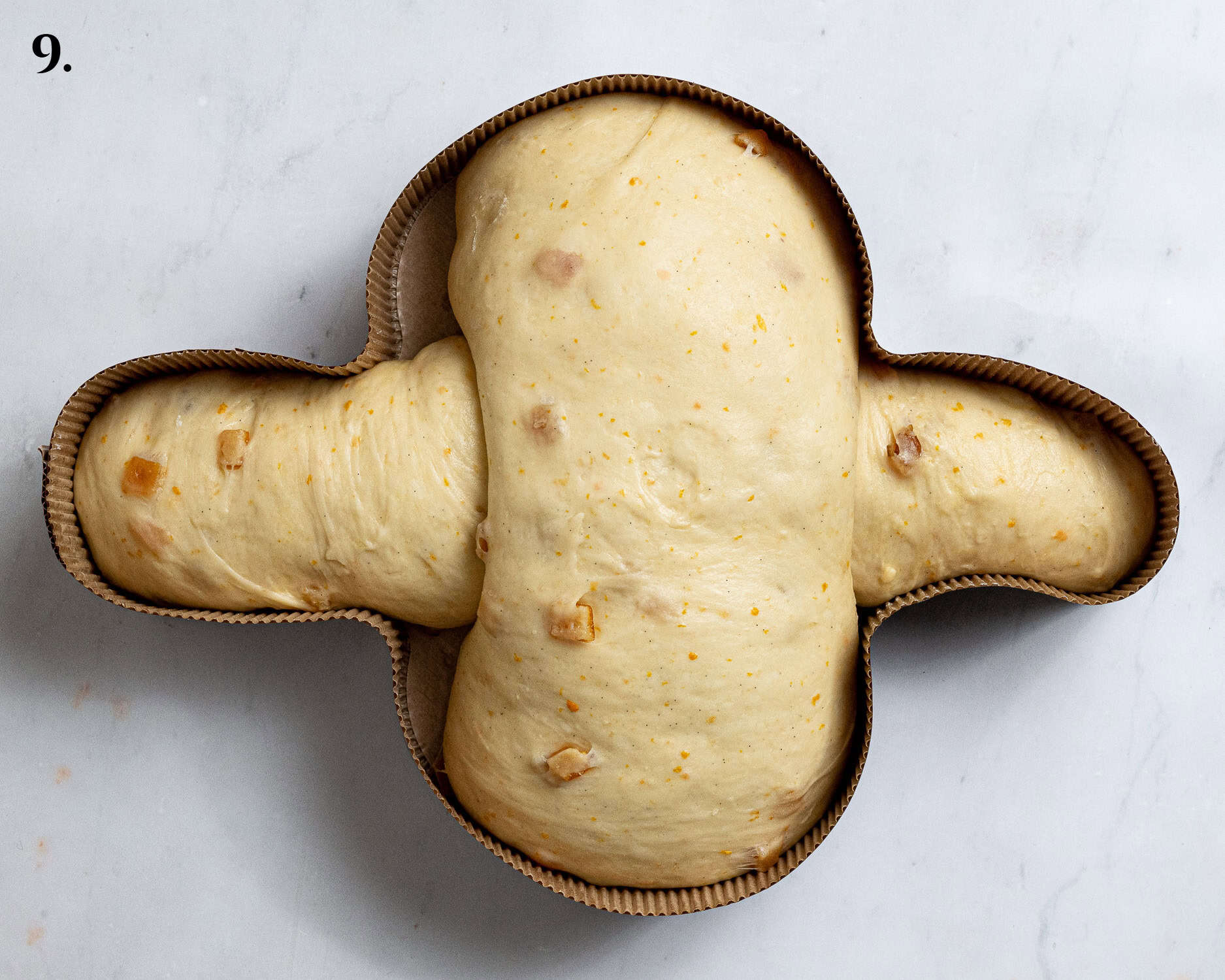
- Step 9: Cover and set aside to rise until the dough has almost reached the top of the mold.
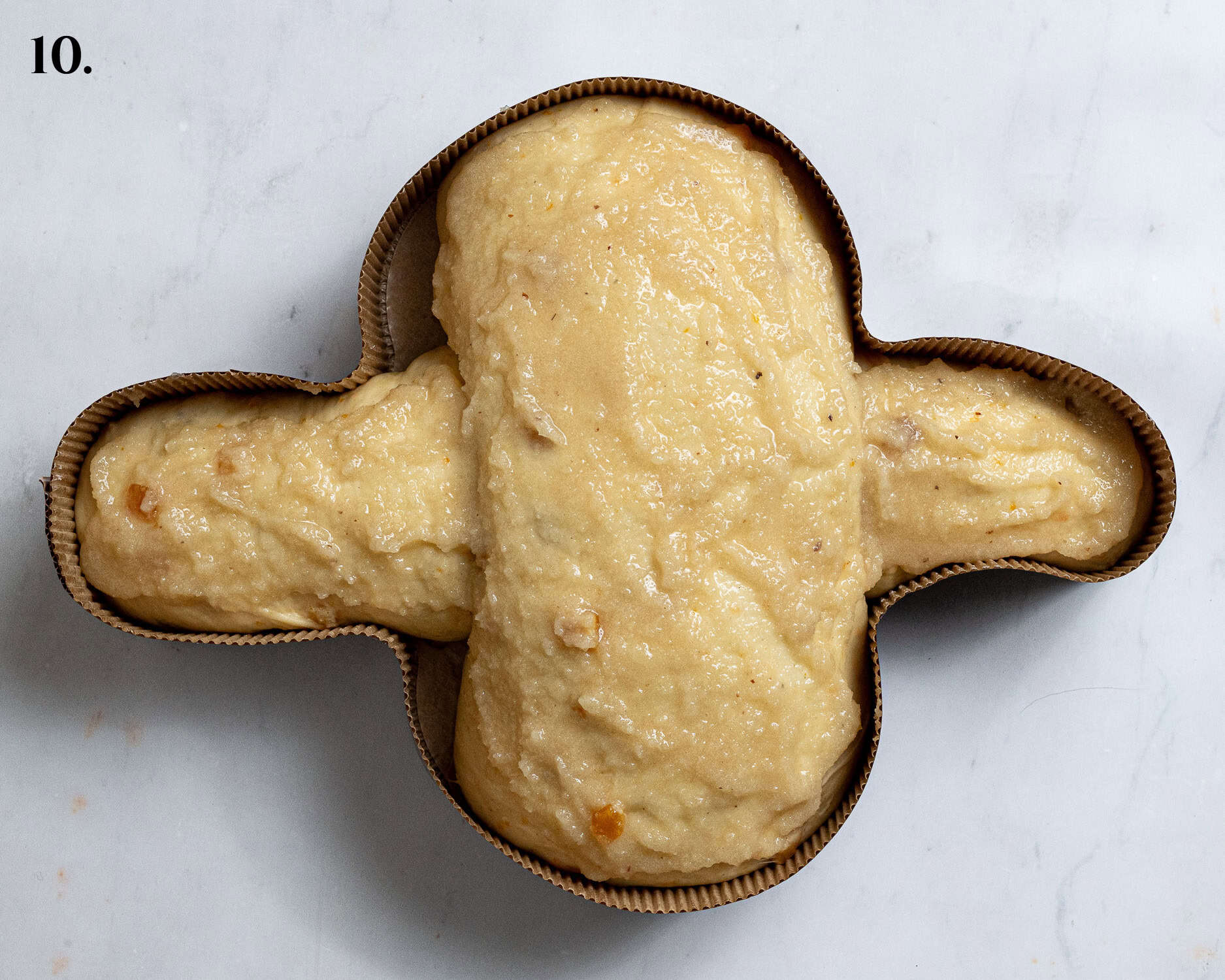
- Step 10: Gently spread the almond topping over the dough.
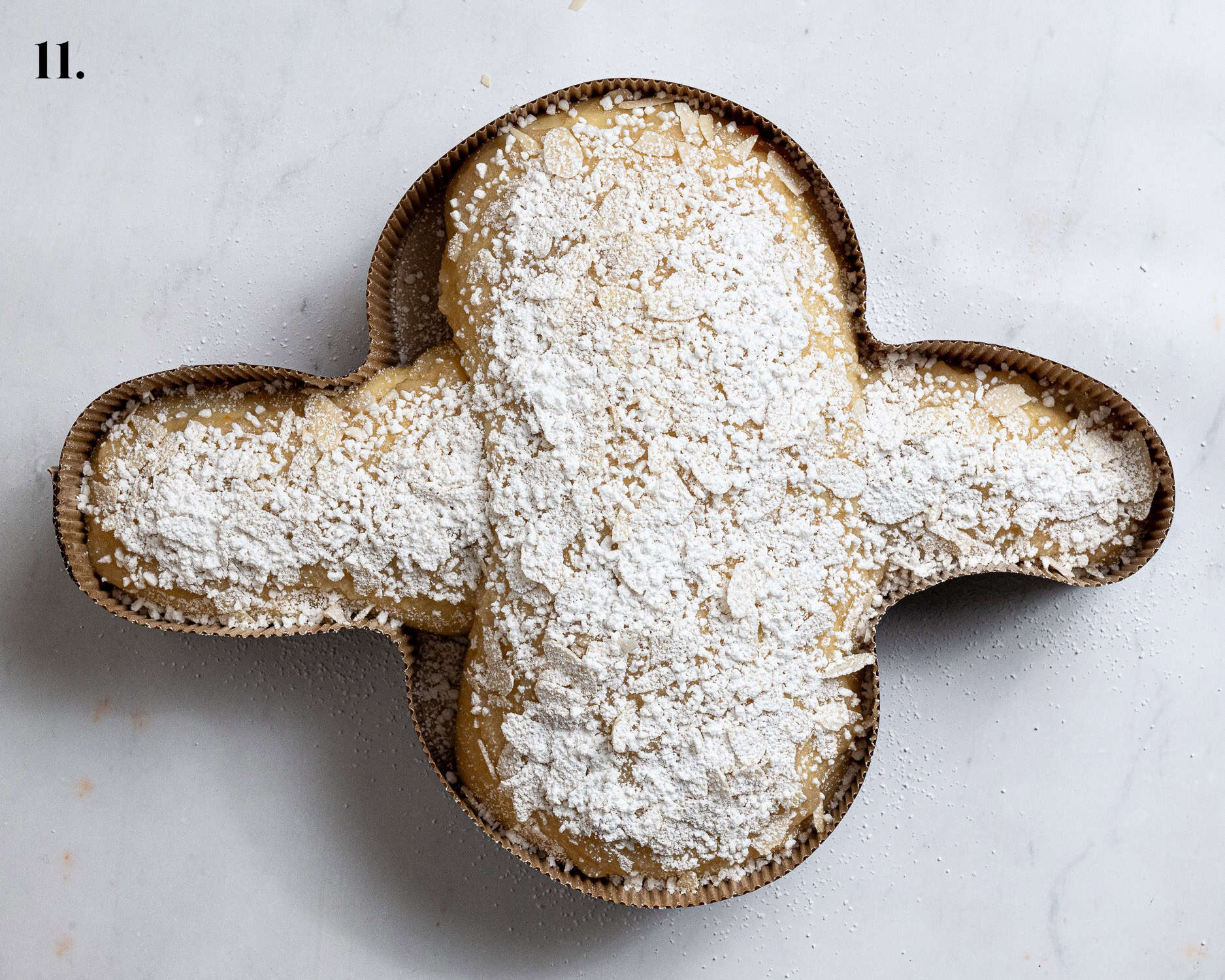
- Step 11: Sprinkle over the pearl sugar and flaked almonds, then dust with icing sugar.
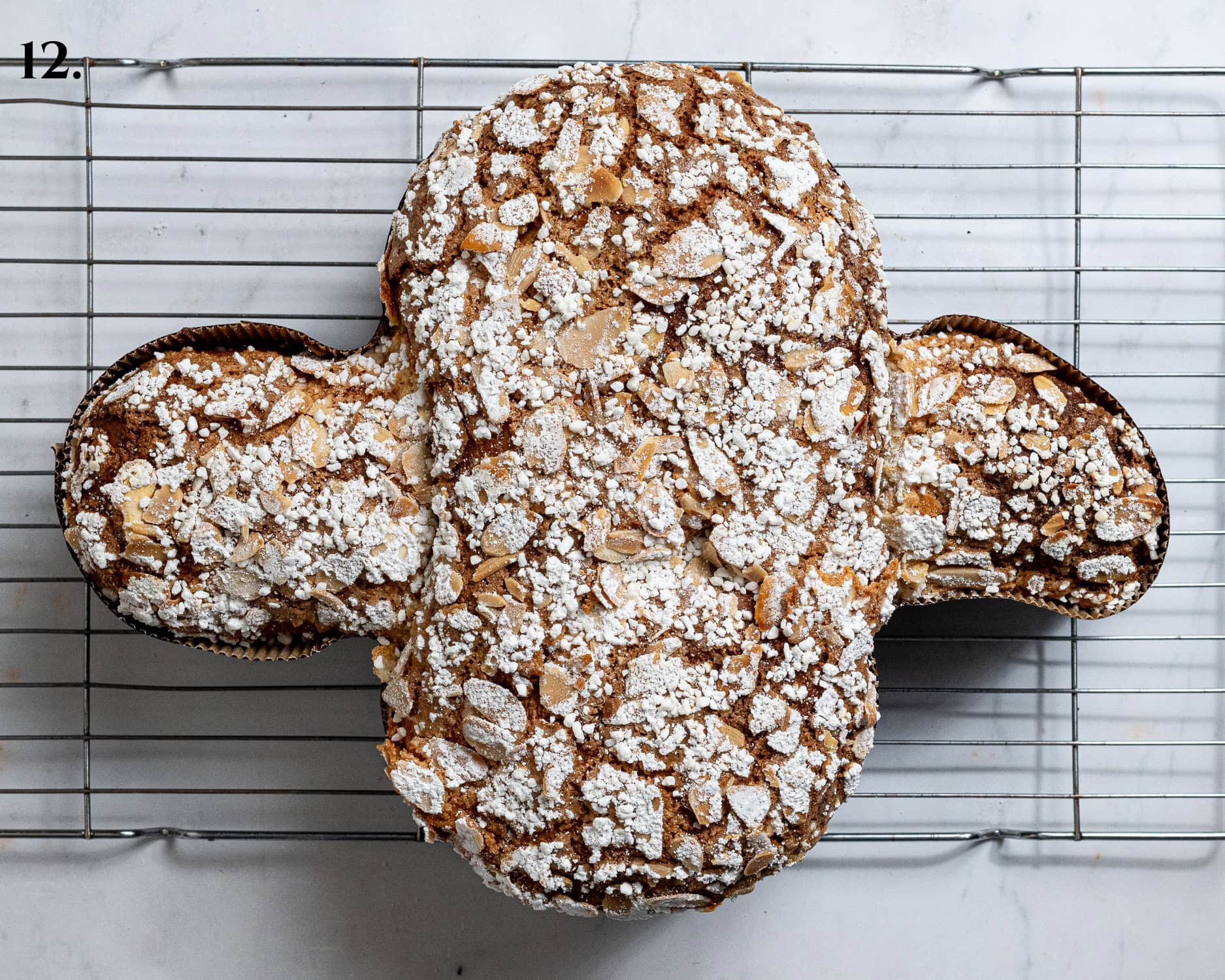
- Step 12: Bake for 55-60 minutes until the internal temperature has reached 94°C / 200°F.
Top Tips:
Make sure that you read through the recipe fully before starting so that you are able to time everything properly!
The recipe is made over 2 days, making a starter in the evening which is left to ferment overnight, then making the first and second doughs, rising, shaping, rising again and baking on the second day. The dough takes a long time to rise as it is so heavily enriched, so make sure that you start the first dough early enough in the morning that you will have time to complete the recipe by the evening; I usually make the first dough at around 7.30am and have the panettone baked by about 6pm.
I have not provided US cup measures for this recipe as they are too inaccurate, please use a digital scale.
Traditionally, Colomba Pasquale is cooled upside-down to prevent it from sinking as it cools, helping to keep it light and fluffy. I am unable to do so as I don't have any skewers long enough; the Colomba sank slightly, but not enough to be a problem. If you want to try cooling yours upside-down you will need to skewer it through the mould on either side near the bottom, using two very long metal skewers, then suspend it between two tall objects such as stacks of books, tall boxes or jars, or a couple of chairs. Note that you may risk some of the topping falling off if you do decide to cool it upside-down, as the vegan topping does not adhere quite as well as one made with egg white.
This homemade vegan Colomba Pasquale is slightly less light than a shop-bought mass produced version, but it is still incredibly soft and delicious.
Instead of making one large 1kg Colomba Pasquale you could make two 500g ones. The bake time would be less, potentially 40 minutes but I can't say for sure without testing it.
Use a a probe thermometer to test when the Colomba Pasquale is cooked through. It should register 94°C / 200°F.
I recommend warming it through slightly before serving for the softest result.
FAQ's:
A poolish is a type of pre-ferment used in bread making to add flavour, improve the texture and help the bread to keep for longer. It is a wet mixture of usually equal quantities of flour and water with a small amount of yeast, and is generally left to ferment overnight before adding it to your dough.
Many recipes for home-made panettone or Colomba call for a biga, which is another type of pre-ferment. Technically a biga is a lower hydration, stiffer dough, whereas a poolish is a wet batter, but people often confuse the two and use the terms interchangeably. Either a biga or a poolish works well to add complexity of flavour and improve the structure of the dough but this recipe uses a poolish.
Store the Colomba in an airtight container or sealed bag at room temperature for up to a week. It is best eaten within a couple of days of baking but as it gets a bit older it is great toasted or warmed through before serving. If it gets too stale then you can use it to make bread and butter pudding!
Yes! This vegan Colomba Pasquale freezes really well. Make sure that it is well wrapped to avoid freezer burn then freeze for up to 3 months. Allow to defrost at room temperature to serve.
Technically yes though it will be a long and messy process as it is a sticky dough and must be kneaded until it is extremely stretchy and stringy. I recommend using a stand mixer if possible.
When kneading, you shouldn't flour the surface as you will end up incorporating too much flour and making the dough too dry. Instead, if the dough is sticking too much, you can lightly oil the worksurface and your hands to help, or just be prepared to get a bit sticky!
A bench scraper is incredibly handy when kneading dough by hand to unstick the dough from the surface.
No, definitely not. Making gluten free bread is tricky and the entire recipe would need reworking. Gluten free baking is not my area of expertise so I cannot advise you. It is best to use a recipe that is designed to be gluten free rather than trying to adapt a non gluten free recipe.
More Vegan Easter Bread Recipes:


If you love this recipe, please leave a 5-star ★★★★★ rating at the bottom of the page! This provides helpful feedback to both me and other readers.
Also be sure to add us as a trusted site on Google so that our recipes show up more in your searches!
To keep up to date with all my latest recipes you can subscribe to my newsletter and follow along on social media!
All images and content on Domestic Gothess are copyright protected. If you want to share this recipe then please do so by using the share buttons provided. Do not screenshot or post the recipe or content in full, instead include a link to this post for the recipe.
Vegan Colomba Pasquale
Equipment
- 1kg Colomba Pasquale mould
- probe thermometer
- stand mixer
- digital scale
Ingredients
Poolish:
- 100 g manitoba flour or panettone flour or strong white bread flour
- 100 g cool water
- ⅛ teaspoon fast action instant yeast
First Dough:
- 200 g manitoba flour or panettone flour or strong white bread flour
- 200 g unsweetened soya milk lukewarm
- 40 g vegan block butter softened
- 11 g fast action instant yeast
Second Dough:
- 180 g manitoba flour or panettone flour or strong white bread flour
- 130 g caster or granulated sugar
- 2 teaspoons vanilla bean paste or extract
- 2 teaspoons orange extract or orange blossom water
- finely grated zest of 2 large oranges
- 100 g vegan block butter softened
- 8 g (1 ¼ teaspoons) fine table salt
- 150 g candied peel
Topping:
- 30 g ground almonds (almond flour)
- 30 g soya milk
- 40 g caster or granulated sugar
- 30 g flaked almonds (or whole almonds)
- 2 Tablespoons pearl sugar
- icing (powdered) sugar for dusting
Instructions
- Make sure that you have read through the entire recipe before you start so that you understand each step and the timings required.
Poolish:
- The evening before the day you want to bake the Colomba Pasquale, prepare the poolish by mixing together the flour, water and yeast in a bowl until well combined. Cover tightly and leave to ferment at cool room temperature overnight, 8-12 hours.100 g manitoba flour, 100 g cool water, ⅛ teaspoon fast action
First Dough:
- The following morning the poolish should look bubbly. To make the first dough, scrape the poolish into the bowl of a stand mixer fitted with a dough hook, add the flour, lukewarm milk, yeast and butter and mix until well combined with no dry patches of flour; it should be quite wet, almost more of a batter than a dough. Cover and let rise until doubled in size, about 1-2 hours at warm room temperature. (I just leave it in the stand mixer bowl to rise).200 g manitoba flour, 200 g unsweetened soya milk lukewarm, 40 g vegan block butter softened, 11 g fast action
Second Dough:
- Once the first dough has risen, add the flour, sugar, vanilla and orange extracts and orange zest to the bowl.180 g manitoba flour, 130 g caster or granulated sugar, 2 teaspoons vanilla bean paste or extract, 2 teaspoons orange extract or orange blossom water, finely grated zest of 2 large oranges
- Knead with the stand mixer until the dough is very smooth, elastic and looks like it is forming strings as it mixes (see post above for reference photo). Check the temperature every now and again with a probe thermometer and do not allow the dough to become too warm, it should never exceed 28°C/82℉. If it starts to get too warm, refrigerate the bowl for 5 minutes before continuing to knead.
- Add in the butter a little at a time, allowing each addition to be incorporated fully before adding more. The dough should be soft and sticky, do not add extra flour.100 g vegan block butter softened
- Once all of the butter has been added, sprinkle in the salt and mix until combined. The dough should pass the windowpane test - you should be able to stretch it thinly enough to see light through it without it tearing.8 g (1 ¼ teaspoons) fine table salt
- Finally add the candied peel, mix until evenly distributed.150 g candied peel
- Lightly oil a large bowl and your hands, shape the dough into a ball as best you can. Place it in the oiled bowl, cover and set aside to rise at warm room temperature until tripled in size, about 3 ½ - 4 ½ hours.
Final Shaping And Rising:
- Once the second dough has risen, use your hands to scoop it up and fold it back on itself a couple of times to deflate it. Turn it out onto an unfloured surface and divide it into two pieces, one just slightly larger than the other, shape each into a ball.
- Flatten the smaller piece out into a rough rectangle then roll it up tightly into a log. Roll it out into a skinny log just slightly shorter than the length of the Colomba mould. Place it seam side down lengthways in the mould to form the head and tail of the dove. Make an indent in the middle where the wings are.
- Flatten the other ball of dough out into a rectangle as before, and roll up tightly into a log. Make this one shorter and fatter than the other, slightly shorter than the width of the mould. Lay it seam side down across the other piece of dough to make the wings and body of the dove.
- Cover and leave to rise at warm room temperature until it has at least doubled in size and almost reached the top of the mold, if you look at it from the side the centre of the dough should be peeking above the mold, but the sides should be about an inch below the top. If you poke it with a floured finger the dough should spring back most of the way but leave a small indentation. This will take about 3 hours at warm room temperature but could take longer if it is cold.
- While the dough is rising mix together the ground almonds, milk and caster sugar for the glaze.30 g ground almonds (almond flour), 30 g soya milk, 40 g caster or granulated sugar
- When the dough is nearly ready, preheat the oven to 200℃/180℃ fan/400℉/gas mark 6. Uncover the Colomba and allow to sit uncovered for 15-20 minutes while the oven heats up.
- When the Colomba is ready to bake, very gently spread the glaze over the top of the dough, being careful not to deflate it. I find it easiest to use my hands to spread it.
- Scatter the flaked almonds and pearl sugar over the glaze, then dust with icing sugar.30 g flaked almonds (or whole almonds), 2 Tablespoons pearl sugar, icing (powdered) sugar for dusting
- Place the Colomba on a baking sheet in the middle of the oven. Bake for 10 minutes, then turn the oven down to 180℃/160 fan/350℉/gas mark 4. Bake for a further 45-50 minutes, until the internal temperature has reached 94°C / 200°F on a probe thermometer. Loosely cover with tin foil after about 40 minutes to prevent the top from burning before it is cooked through.
- Place the Colomba on a wire cooling rack and allow to cool completely before serving.
Notes
- See post above for tips, details, step-by-step photos, storage and freezing instructions.
- The dough takes a long time to rise as it is so heavily enriched, so make sure that you start the first dough early enough in the morning that you will have time to complete the recipe by the evening; I usually make the first dough at around 7.30am and have the Colomba Pasquale baked by about 6pm.
- I have not provided US cup measures for this recipe as they are too inaccurate, please use a digital scale.
- This is a complex recipe with very little margin for error. I would not necessarily recommend attempting this recipe if you are a beginner bread maker; you need to be able to competently shape dough and recognise when it is properly kneaded and prooved.
- Traditionally, Colomba Pasquale is cooled upside-down to prevent it from sinking as it cools, helping to keep it light and fluffy. I am unable to do so as I don't have any skewers long enough; the Colomba sank slightly, but not enough to be a problem. If you want to try cooling yours upside-down you will need to skewer it through the mould on either side near the bottom, using two very long metal skewers, then suspend it between two tall objects such as stacks of books, tall boxes or jars, or a couple of chairs. Note that you may risk some of the topping falling off if you do decide to cool it upside-down, as the vegan topping does not adhere quite as well as one made with egg white.
If you tried this recipe let me know how it went! Rate it, leave a comment or tag @domestic_gothess on Instagram and hashtag it #domesticgothess

Leave a Reply