

Olive oil cinnamon rolls - these delicious vegan cinnamon rolls are made with olive oil instead of butter and use the tangzhong method to keep them soft, light and fluffy.
Topped with a sweet vanilla glaze they are gooey, squishy, nicely spiced and utterly moreish!

I love my classic tangzhong vegan cinnamon rolls recipe but I wanted to create one for people who either can't get hold of vegan butter or would rather not use it.
This version is still made using the tangzhong method which helps make them super soft, light and fluffy, but the butter in both the dough and the filling is replaced with olive oil.
It keeps them rich, tender and flavourful but is a healthier fat option than vegan butter (note that these are not actually healthy, they are still cinnamon rolls after all!).

Ingredient Details:
Olive oil: I use extra virgin olive oil, the flavour doesn't come through strongly but you can use regular olive oil instead if you want. You could also use another oil such as vegetable, avocado or sunflower.
Bread flour: White bread flour helps to give these olive oil cinnamon rolls their soft, fluffy, chewy texture. Plain (all-purpose) flour will also work though the texture isn’t quite the same. I don’t recommend using wholemeal flour as that will make the rolls too dense.
Instant yeast: I always prefer to use instsant yeast when making bread as it can just be added straight to the flour and doesn’t need to be activated first.
Salt: You simply cannot make good bread without salt. Don’t omit it.
Non-dairy milk: Soy milk is always my favourite for baking as it has the highest protein content so most closely resembles dairy milk. Any variety of non-dairy milk will work however, but go for an unsweetened one if you can, and definitely soy milk if you have it.
Sugar: I use caster sugar in the dough and light brown soft sugar in the filling. The caster sugar can be swapped for granulated, and you can use dark, rather than light brown sugar if you want a stronger molasses flavour. You can also use coconut sugar for a natural sweetener option.
If you want to make the glaze then you will also need icing (powdered) sugar.
Cinnamon: Obviously you can't make cinnamon rolls without cinnamon! I use ceylon cinnamon which has a more delicate flavour than cassia, if you are using cassia cinnamon then you may want to use a bit less of it. You can also add some other spices if you like - cardamom or nutmeg would work well, or you can swap the cinnamon for pumpkin spice.

How To Make Olive Oil Cinnamon Rolls:
(Full measurements and instructions can be found in the recipe card at the bottom of the page)

- Step 1: To make the tangzhong, place the flour in a saucepan and gradually whisk in the milk. Place the pan over a low heat and whisk constantly until the mixture has thickened to a paste/pudding-like consistency.

- Step 2: Scrape the tangzhong into the bowl of a stand mixer fitted with a dough hook and pour the cold milk on top. Add sugar, olive oil, vanilla, salt, flour and yeast.

- Step 3: Stir until it forms a rough dough then set the stand mixer to a medium speed and mix until the dough is smooth and stretchy. It will be very soft and sticky but should pull away from the sides of the bowl cleanly.

- Step 4: Use oiled hands to shape the dough into a ball, place in an oiled bowl, cover and set aside to rise until doubled.

- Step 5: To make the filling, stir together the sugar, cinnamon, flour, salt, olive oil and milk to form a spreadable paste.

- Step 6: Punch down the risen dough and roll it out on a floured surface into a large rectangle. Spread over the filling.

- Step 7: Roll the dough up tightly from one of the long edges. Slice it into 9 even pieces, unflavoured dental floss is the best way to do this neatly.

- Step 8: Place the rolls in a lined 23 cm square tin. Cover and set aside to rise until puffy.

- Step 9: Bake the rolls for 25-30 minutes.

Top Tips:
USE SCALES. As with all of my baking recipes I really do recommend using the metric measurements with a digital scales rather than the cup conversions. Cups are a wildly inaccurate measuring system and you will get far better, more consistent results using a scale, not to mention that it is also easier and less messy than cups!
Tablespoon and teaspoon measurements are for proper measuring spoons, NOT regular kitchen spoons. A Tablespoon is 15ml and a teaspoon is 5ml and they should be level, not heaped.
Make sure that your yeast isn't out of date! Old yeast can lead to dough that doesn’t rise.
The rising time of the dough will vary depending on how warm it is; on hot days it will rise much faster than on cold ones.
If you want, you can give the dough it’s first rise overnight in the fridge rather than at room temperature. This breaks up the workload and gives the bread an even better flavour.
The best way to slice the log of dough neatly is to use unflavoured dental floss (though I don't see a flavoured one being an issue); a sharp knife is fine as well though if you don't have any floss.
The best way to tell if a loaf of bread is cooked in the middle is to use a probe thermometer. It is impossible to give a one-size-fits-all baking time as ovens vary so much. The bread should be done when it reaches 90°C / 195°F.
I like to cover the tray of cinnamon rolls with a tea towel while they cool to seal in moisture and keep them soft.
The glaze is optional, the rolls are sweet enough without it, but it does help keep them soft and moist. You could also use a cream cheese glaze instead if you prefer.
FAQ's:
Store the olive oil cinnamon rolls in an airtight container at room temperature for up to 3 days. I recommend warming them through gently before serving.
Yes they freeze really well. Allow them to cool completely then freeze on the day they are baked to preserve freshness, make sure that they are well wrapped to prevent freezer burn. Allow them to defrost at room temperature then refresh in a low oven for 5-10 minutes or in the microwave for 10-20 seconds before serving. I do not recommend freezing unbaked rolls.
This is a very soft, sticky dough so I absolutely recommend using a stand mixer if you have one. You can knead it by hand if you don't have one, just be prepared to get a bit messy.
When kneading, you shouldn't flour the surface as you will end up incorporating too much flour and making the dough too dry. Instead, if the dough is sticking too much, you can lightly oil the worksurface and your hands to help, or just be prepared to get a bit sticky!
A bench scraper is incredibly handy when kneading dough by hand to unstick the dough from the surface.
No, I’m afraid that you cannot use gluten free flour. Making gluten free bread is tricky and the entire recipe would need reworking. Gluten free baking is not my area of expertise so I cannot advise you. It is best to use a recipe that is designed to be gluten free rather than trying to adapt a non gluten free recipe.


More Vegan Cinnamon Rolls:
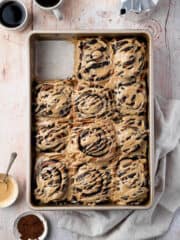

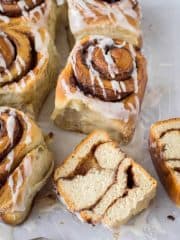

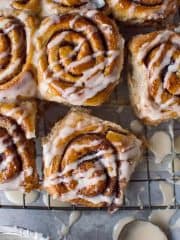
If you tried this recipe let me know how it went! Rate it, leave a comment or tag @domestic_gothess on Instagram and hashtag it #domesticgothess
All images and content on Domestic Gothess are copyright protected. If you want to share this recipe then please do so by using the share buttons provided. Do not screenshot or post the recipe or content in full, instead include a link to this post for the recipe.

Olive Oil Cinnamon Rolls (vegan)
Ingredients
Tangzhong:
- 25 g (3 Tablespoons) white bread flour
- 140 g (½ cup + 4 teaspoons) unsweetened non-dairy milk (I use soy)
Dough:
- 170 g (⅔ cup + 2 teaspoons) unsweetened non-dairy milk (I use soy) cold
- 40 g (3 Tablespoons) caster or granulated sugar
- 55 g (¼ cup) olive oil (either extra virgin or regular)
- 360 g (3 cups) white bread flour
- 2 teaspoons vanilla extract
- ½ teaspoon salt
- 7 g (2 ¼ teaspons) instant/fast action yeast
Filling:
- 140 g (12 Tablespoons) light brown soft sugar
- 5 teaspoons ceylon cinnamon (4 if using cassia)
- 40 g (3 Tablespoons) olive oil
- 10 (1 Tablespoon) bread flour
- ¼ teaspoon salt
- 1 Tablespoon non-dairy milk
Glaze:
- 120 g (1 cup) icing (powdered) sugar
- ½ teaspoon vanilla extract
- 1-2 Tablespoons non-dairy milk
Instructions
- To make the tangzhong, place the flour in a saucepan and gradually whisk in the milk to avoid lumps. Place the pan over a medium/low heat and whisk constantly until the mixture has thickened to a soft paste/pudding-like consistency.25 g (3 Tablespoons) white bread flour, 140 g (½ cup + 4 teaspoons) unsweetened non-dairy milk (I use soy)
- Scrape the tangzhong into the bowl of a stand mixer fitted with a dough hook and pour the cold milk on top. This will cool the tangzhong down so that it doesn't kill the yeast.170 g (⅔ cup + 2 teaspoons) unsweetened non-dairy milk (I use soy)
- Add the sugar, olive oil, vanilla, salt, flour and finally the yeast.40 g (3 Tablespoons) caster or granulated sugar, 55 g (¼ cup) olive oil (either extra virgin or regular), 360 g (3 cups) white bread flour, 2 teaspoons vanilla extract, ½ teaspoon salt, 7 g (2 ¼ teaspons) instant/fast action yeast
- Mix on a low speed until it forms a rough dough then turn up the speed to medium and mix until the dough is smooth and stretchy and pulls away from the sides of the bowl cleanly, about 10 minutes. You should be able to stretch a section of the dough thin enough to see light through it without it breaking (the windowpane test). It is a very soft, sticky dough; resist the urge to add extra flour unless the dough doesn't start to pull away cleanly.
- Lightly oil a large bowl and your hands then shape the dough into a ball. Place the dough in the bowl, cover and set aside to rise in a warm spot until doubled in size, 1-2 hours.
- To make the filling, mix the brown sugar, cinnamon, olive oil, flour, salt and milk together in a bowl to form a spreadable paste. Line an approx 23 cm/9 in square tin with baking paper.140 g (12 Tablespoons) light brown soft sugar, 5 teaspoons ceylon cinnamon (4 if using cassia), 40 g (3 Tablespoons) olive oil, 10 (1 Tablespoon) bread flour, ¼ teaspoon salt, 1 Tablespoon non-dairy milk
- Knead the risen dough very briefly to knock out any air bubbles then roll it out on a lightly floured surface to an approx 30 x 40 cm/12 x 16 in rectangle.
- Spread the cinnamon filling evenly over the dough. It can be a bit difficult to spread, just do your best and it doesn't matter if it isn't totally even; I find it easier to use my hands to spread it.
- Roll the dough up tightly from one of the long sides into a sausage. Place it seam side down.
- Slice the roll into 9 even pieces. The best way to get a clean cut is to place a piece of unflavoured dental floss under the sausage where you want to make the cut, cross the ends of the floss over each other and pull. Otherwise you can use a very sharp knife to slice it.
- Arrange the rolls in the prepared tin. Cover loosely and set aside to rise for about 30-45 minutes until they are nice and puffy. If you press one gently the dough should spring back slowly most of the way but leave a small indentation. If it springs back quickly and fills in all the way then they need a little bit longer. While they are rising preheat the oven to 180°C/160°C fan/350°F/gas mark 4.
- Once the buns have risen, bake for 25-30 minutes, until nicely browned and the internal temperature reaches 90°C/194°F on a probe thermometer. If any of the centers of the cinnamon rolls pop up, gently press them down after baking.
- Remove from the oven and loosely cover with a tea towel. Allow to cool for about 25 minutes before drizzling with the glaze.
- To make the glaze, sift the icing sugar into a bowl and add the vanilla. Gradually stir in enough milk to form your desired consistency. Drizzle it over the cinnamon rolls and serve.120 g (1 cup) icing (powdered) sugar, ½ teaspoon vanilla extract, 1-2 Tablespoons non-dairy milk
Notes
- See post above for tips, details and step-by-step photos.
- As with all of my baking recipes I really do recommend using the metric measurements with a digital scale rather than the cup conversions. Cups are a wildly inaccurate measuring system and you will get far better, more consistent results using a scale, not to mention that it is also easier and less messy than cups!

Liv
Guys...they're SO light and perfectly soft and pillowy. PERFECTION. Yes, the dough is very sticky, but it's necessary to achieve the perfect result! I've made these 2x in the past week because my husband insisted. I had to make a slight modification because I ran out of soy milk though 🙁
For the tangzhong I used 100 g soy milk + 30 g water and for the main dough 100 g milk + 60 g water.
Also, I only used 1/2 teaspoon of yeast because I wanted to do an overnight rise (bulk ferment) in the fridge. And since it's 25 C in my home the dough proofed easily once at room temp. I shaped the rolls and they were ready to bake after 30 mins of proofing on my countertop.
Fabulous!!!
Irma
Hi! I'd love to make these for an afternoon tea party I'm hosting, but I was wondering if I can make or at least prep these the day before, so that I'm not stressed on the day itself. Do you think that's possible?
Hannah
Hi Irma, you can make the dough the day before and let it rise overnight in the fridge then shape, prove and bake the rolls the following day. Alternatively you could bake the rolls the day before and just heat them through in a low oven before serving.
Irma
Thank you! I will probably try baking them the day before and then reheat them in the oven on the day itself.
Catherin
I followed every step of this recipe, weighing all the ingredients, and the rolls turned out perfectly! I made 12 rolls instead of 9, and baked them for 20 minutes at 180 degrees Celsius. I highly recommend!