

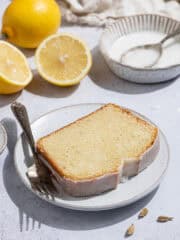
Vegan passion fruit cake - this incredible vegan loaf cake is soft, moist, tender and bursting with tropical fresh passion fruit flavour.
It is easy to make and perfect for snacking, or serve it with coconut ice cream for a delicious dessert.

I absoloutely adore a loaf cake; as much as layer cakes have their place for special occasions, for general every day eating you can't beat a good loaf cake.
This vegan passion fruit loaf cake is so full of sweet, zingy passion fruit flavour, and it has a perfectly soft, tender, buttery crumb. The passion fruit glaze helps to add an extra burst of tangy flavour, with a bit of crunch from the passion fruit seeds for a change of texture.
I adapted my vegan Earl Grey lemon cake to make this, swapping the lemon for passion fruit, upping the fat slightly and swapping some of the oil for butter to give it a plusher crumb.

Ingredient Details:
Passion fruit: I used fresh passion fruits, but you will need a lot of them - around 11-12 medium sized ones. You can also use shop bought unsweetened seedless passion fruit puree which would save you a bit of effort!
If using puree from a carton (frozen is also fine) rather than fresh fruit, make sure that it is 100% passion fruit with no added sugar, I like this one which I order online.
Oil + vegan butter: Using a mixture of oil and butter in the cake gives you the best of both worlds - both flavour and moisture. Any neutral oil will work (except coconut), I use olive. For the butter you ideally need to use a block variety rather than the spreadable kind in a tub.
Non-dairy yogurt: I love using plant yogurt in vegan cakes, it is a great egg replacer and keeps the cake moist as well as adding flavour.
Either soy or coconut yogurt will work, ideally a thick, Greek style one. I haven't tested any substitutes for the yogurt I'm afraid.
Sugar: Caster or granulated sugar is best. Do not use sweeteners or liquid sugars instead. You will also need icing (powdered) sugar for the glaze.
Baking powder and soda: Using both baking powder and bicarbonate of soda (baking soda) will give you the best rise and texture. Don't swap one for the other, you will not get the same result.
Plain flour and cornflour: Regular plain (all-purpose) flour with a bit of cornflour (cornstarch) added gives the crumb a nice texture. You can swap the cornflour for an equal weight of plain flour if you don't have any, but I do recommend using it if you can.
Vanilla: I like to use vanilla bean paste here for the best flavour.

How To Make Vegan Passion Fruit Cake:
(Full measurements and instructions can be found in the recipe card at the bottom of the page)

- Step 1: If using fresh passion fruits, briefly pulse the flesh in a food processor or blender to separate the juice from the seeds, then press it through a fine mesh sieve to extract as much juice as possible.

- Step 2: Weigh out 120g of the seedless passion fruit juice and whisk in the yogurt, sugar, oil, melted butter and vanilla extract.

- Step 3: Whisk in the cornflour, baking powder and soda and salt, followed by the plain flour.

- Step 4: Pour the batter into a lined 2lb loaf tin.

- Step 5: Bake for 60 minutes.

Top Tips:
All of my recipes are developed using grams, and as with all of my baking recipes I really do recommend using the metric measurements with a digital scale rather than the cup coversions. Cups are a wildly inaccurate measuring system and you will get far better, more consistent results using a scale, not to mention that it is also easier and less messy than cups!
Tablespoon and teaspoon measurements are for proper measuring spoons, NOT regular kitchen spoons. A Tablespoon is 15ml and a teaspoon is 5ml and they should be level, not heaped.
Be careful not to over-beat the batter as that can make the cake tough, just stir it by hand with a balloon whisk (not an electric mixer) until no dry lumps remain.
If you want to make sure that the cake has a perfect crack down the centre, dip a butter knife in oil and run it through the batter before putting it in the oven.
The cake is ready when it is firm to the touch and a skewer inserted into the centre comes out clean or with a few moist crumbs but no wet batter.
If using fresh passion fruit, blitz the pulp in a food processor or blender for a few seconds before pressing it through a fine mesh sieve, this helps to separate the juice from the seeds.
Intead of the glaze, you could top the cake with vegan passion fruit curd.
FAQ's:
This vegan passion fruit cake will keep in an airtight container at room temperature for around 3 days or in the fridge for 5.
Yes this cake freezes well, either whole or in slices. Make sure that it has cooled completely first then wrap it well to avoid freezer burn and freeze for up to 3 months. Allow to defrost at room temperature.



Stay in touch with me through social media @ Instagram, Pinterest and Facebook, and subscribe via email to get all our latest recipes!
All images and content on Domestic Gothess are copyright protected. If you want to share this recipe then please do so by using the share buttons provided. Do not screenshot or post the recipe or content in full, instead include a link to this post for the recipe.

Vegan Passion Fruit Cake
Ingredients
Cake:
- 120 g (½ cup) seedless passion fruit puree* (see notes)
- 180 g (¾ cup) vegan Greek style yogurt
- 200 g (1 cup) caster or granulated sugar
- 55 g (¼ cup) neutral oil (olive/sunflower/canola/avocado)
- 100 g (7 Tablespoons) vegan block butter melted
- 1 Tablespoon vanilla bean paste or extract
- 20 g (2 packed Tablespoons) cornflour (cornstarch)
- 2 teaspoons baking powder
- ¼ teaspoon bicarbonate of soda (baking soda)
- ¼ teaspoon salt
- 270 g (2 ¼ cups) plain (all-purpose) flour
Glaze:
- pulp from 1 passion fruit (including seeds)
- 15 g (1 Tablespoon) vegan block butter melted
- 115 g (1 cup) icing (powdered) sugar
- a squeeze of lime/lemon juice as needed
Instructions
- Preheat the oven to 180°C/160℃ fan/350°F/gas mark 4. Grease a 2lb loaf tin and line it with greaseproof paper.
- If using fresh passion fruits, briefly pulse the flesh in a food processor or blender to separate the juice from the seeds, then press it through a fine mesh sieve to extract as much juice as possible. Weigh out 120g of seedless pulp; if you are slightly short you can top it up with non-dairy milk to 120g.
- In a large bowl whisk together the seedless passion fruit pulp, yogurt, sugar, oil, melted butter and vanilla.120 g (½ cup) seedless passion fruit puree* (see notes), 180 g (¾ cup) vegan Greek style yogurt, 200 g (1 cup) caster or granulated sugar, 55 g (¼ cup) neutral oil (olive/sunflower/canola/avocado), 100 g (7 Tablespoons) vegan block butter, 1 Tablespoon vanilla bean paste or extract
- Whisk in the cornflour, baking powder, bicarbonate of soda and salt, followed by the plain flour. Mix until no dry lumps remain but be careful not to overbeat the batter.20 g (2 packed Tablespoons) cornflour (cornstarch), 2 teaspoons baking powder, ¼ teaspoon bicarbonate of soda (baking soda), ¼ teaspoon salt, 270 g (2 ¼ cups) plain (all-purpose) flour
- Scrape the mixture into the prepared loaf tin and bake for about 60 minutes until a skewer inserted into the centre comes out clean.
- Leave the cake to cool in the tin for 10 minutes then carefully turn it out onto a wire rack and leave to cool completely.
- Once the cake has cooled make the glaze; sift the icing sugar into a bowl and stir in the passion fruit pulp and melted butter to form a thick but spoonable glaze. Add more icing sugar if it is too runny or a squeeze of lime or lemon juice if it is too thick.pulp from 1 passion fruit (including seeds), 15 g (1 Tablespoon) vegan block butter, 115 g (1 cup) icing (powdered) sugar, a squeeze of lime/lemon juice as needed
- Spoon the glaze over the cake and serve. Store in an airtight container at room temperature.
Notes
- *You will need approximately 10-11 medium sized passion fruits to extract 120g of seedless pulp. Alternatively you can use passion fruit pulp from a carton/frozen pulp; in this case make sure that it is 100% passion fruit with no added sugar or water.
- All of my recipes are developed using grams, and as with all of my baking recipes I really do recommend using the metric measurements with a digital scale rather than the cup coversions. Cups are a wildly inaccurate measuring system and you will get far better, more consistent results using a scale, not to mention that it is also easier and less messy than cups!
- See post above for tips, details and step-by-step photos.
- If you want to make sure that the cake has a perfect crack down the centre, dip a butter knife in oil and run it through the batter before putting it in the oven.
If you tried this recipe let me know how it went! Rate it, leave a comment or tag @domestic_gothess on Instagram and hashtag it #domesticgothess
Leave a Reply